




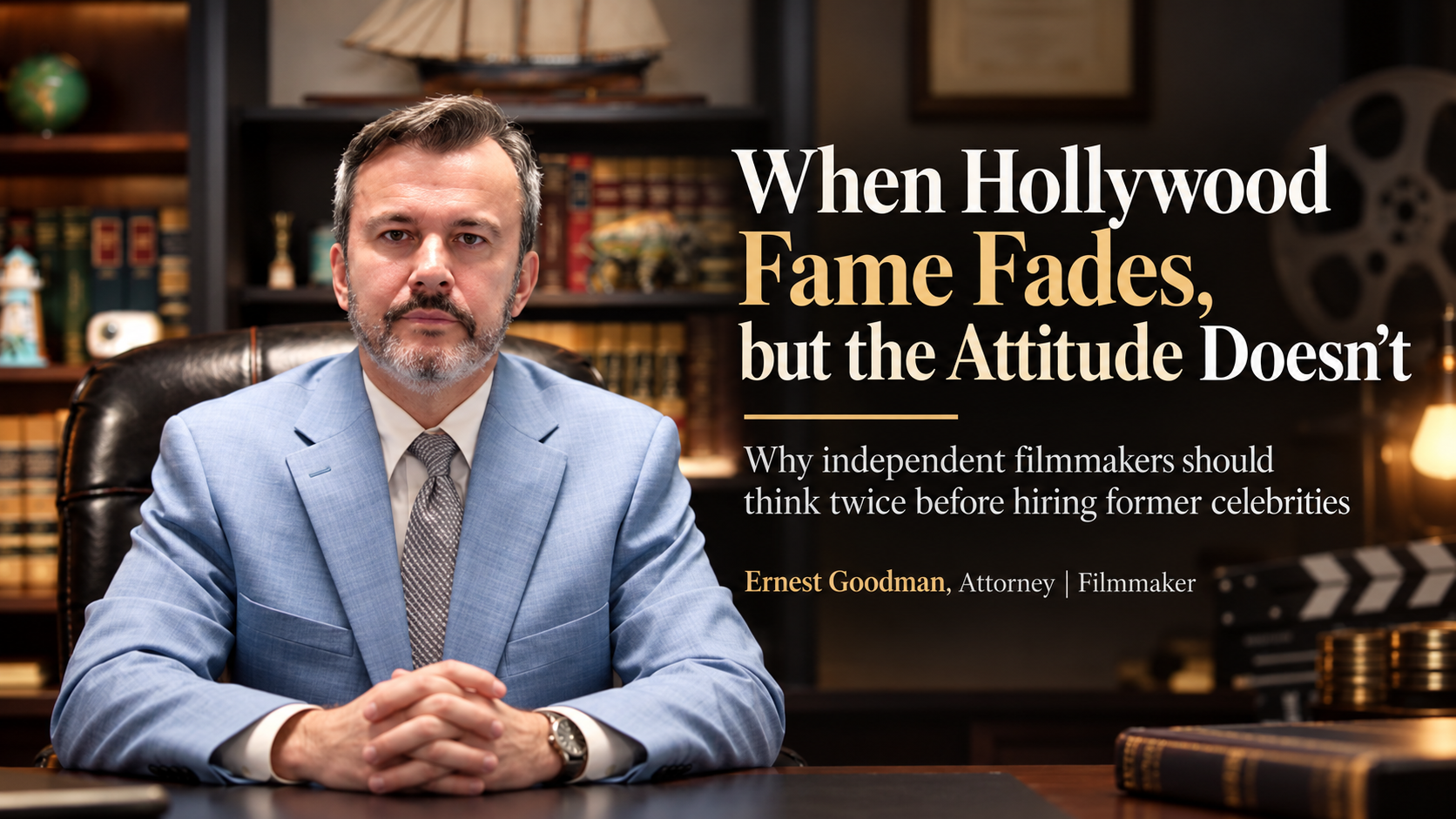
When Hollywood Fame Fades, but the Attitude Doesn’t
Hello everyone!
Why independent filmmakers should think twice before hiring former celebrities — and how contracts and artificial intelligence can protect their productions.
Over the years, I have encountered several situations in which independent filmmakers hired former Hollywood stars who had enjoyed considerable fame in the 1980s or 1990s.
The reasoning was understandable. A recognizable name on a movie poster can help attract investors, distributors, foreign buyers, and audiences. For an independent filmmaker struggling to finance and distribute a movie, hiring someone who once starred in major Hollywood productions can seem like an excellent business decision.
Unfortunately, while their fame may have faded, their attitude sometimes hasn’t.
Some performers who once enjoyed celebrity status continue to behave as though they are surrounded by personal assistants, major studio executives, and producers willing to accommodate their every demand.
The problem is that independent filmmaking operates under entirely different financial realities.
A major studio may be able to absorb production delays. An independent filmmaker may lose the entire project.
A Hollywood Actress Who Allegedly Spat in a Producer’s Face
One of my clients was an independent film producer who hired an actress who had enjoyed considerable fame during the 1990s.
According to my client, working with her became a nightmare.
He described her as extremely difficult and confrontational. At one point, she allegedly spat in his face.
She also reportedly failed to appear on set for several days, disrupting the production schedule.
Consider what this means for an independent filmmaker.
A producer has already rented equipment, secured locations, hired a cinematographer, assembled a production crew, arranged transportation, and scheduled other actors.
Everyone is ready to work.
Except the star.
The entire production may be unable to proceed because a single performer refuses or fails to appear.
Meanwhile, expenses continue accumulating.
A producer might lose thousands or tens of thousands of dollars through additional crew expenses, location changes, equipment rentals, rescheduling, and other consequences of interrupted filming.
And what happens if the actress simply refuses to return?
The producer may have to rewrite the screenplay, hire another performer, reshoot completed scenes, or abandon the project entirely.
The celebrity receives publicity and compensation. The independent producer assumes the financial risk.
This is precisely why hiring a former Hollywood celebrity should never be treated as merely a casting decision. It is also a legal and financial risk-management decision.
My Twenty-Minute Audition of Another Former Hollywood Star
Recently, I encountered another former Hollywood actor who had been well known during the 1990s.
His career had declined considerably since his years of prominence.
I happened to observe him at a local gun store.
He walked behind the sales counter, into an area ordinarily reserved for employees, and began handling a rifle.
At one point, he dropped the rifle onto the floor.
He also displayed an unpleasant, dismissive attitude toward a salesperson.
There was no movie camera, no director, no publicist, and no audience expecting a performance.
He was simply interacting with people in an ordinary retail environment.
I observed his behavior for approximately twenty minutes.
That was enough of an audition for me.
I have always believed that watching how someone treats ordinary people can reveal more about their personality than a polished interview, professional résumé, or carefully managed public appearance.
If someone cannot treat a store employee respectfully, I would have serious concerns about how that person might treat a production assistant, makeup artist, assistant director, or independent producer.
Of course, this does not mean every former Hollywood star behaves this way.
Many experienced actors remain exceptionally professional, courteous, punctual, and committed to their craft.
Some are genuinely wonderful people to work with.
But a recognizable name is not evidence of reliability.
And past celebrity status should never excuse unprofessional behavior.
The Real Economics of Hiring a Former Celebrity
Independent filmmakers sometimes overestimate the commercial value of actors whose careers peaked decades ago.
A familiar face may provide marketing value, but name recognition alone does not guarantee distribution, financing, or ticket sales.
Producers should investigate whether the actor still has a meaningful audience, whether distributors actually assign value to the actor’s participation, and whether that value justifies the cost.
They should also investigate the actor’s professional reputation.
I would strongly recommend speaking privately with producers, directors, and production managers who have worked with that performer recently.
Ask straightforward questions.
Did the actor arrive on time? Was the performer prepared? Were there unexplained absences? Did the actor cooperate with the director? Were additional expenses incurred because of the actor’s conduct?
Do not rely exclusively on the actor’s agent or manager.
Agents are paid to secure employment for their clients. Their financial incentives are not necessarily aligned with the producer’s interests.
The most expensive actor is not necessarily the one with the highest salary. Sometimes it is the actor who prevents everyone else from working.
Can Artificial Intelligence Solve the Problem?
This is where modern filmmaking technology becomes particularly interesting.
As both an attorney and filmmaker, I believe artificial intelligence will increasingly become an important tool for protecting independent productions against interruptions.
Imagine a situation in which an actor completes most of the principal photography but subsequently refuses to return for several remaining scenes.
Traditionally, the producer might have limited options: negotiate additional compensation, rewrite scenes, employ a body double, or undertake expensive reshoots.
Today, AI technology may provide another possibility.
Depending on the circumstances, a filmmaker may be able to generate limited additional footage using an authorized digital replica of the performer.
But there is an important legal obstacle.
A producer does not automatically acquire the right to create an actor’s digital replacement simply because the actor breached the employment agreement.
The producer must separately establish the legal right to use the performer’s digital likeness and voice.
And for SAG-AFTRA productions, those rights are subject to collective bargaining requirements.
What SAG-AFTRA Actually Says About AI
In June 2026, SAG-AFTRA members ratified a new television and theatrical agreement containing additional protections governing artificial intelligence and digital replicas.
The 2026 agreement builds upon protections negotiated in 2023 and addresses a rapidly changing technological landscape.
One significant development concerns digital replicas created without physically scanning an actor.
Previously, much of the public discussion focused on scanning performers to create digital models.
However, modern generative AI can sometimes construct recognizable digital likenesses from existing footage or recordings.
The 2026 agreement expressly addresses certain replicas created without the performer’s physical participation.
In other words, a producer generally cannot avoid SAG-AFTRA’s digital replica protections merely by using existing footage instead of asking the actor to undergo a new digital scan.
The agreement also distinguishes between certain permissible digital alterations and uses that require additional consent.
For example, a digital alteration that leaves a performance substantially as scripted, performed, or recorded may qualify for an exception to additional consent requirements.
But creating an entirely new performance, substantially changing dialogue, or generating previously unperformed scenes can raise different contractual obligations.
The intended use, consent requirements, compensation, and applicable agreement must be carefully examined.
AI is a production tool, not an automatic legal exception to performers’ contractual rights.
Can Actors Sign an AI Waiver?
This is one of the most important questions for independent producers.
Suppose a filmmaker includes a provision in the actor’s employment agreement stating:
If the performer fails to appear for scheduled production services without justification, the producer may use artificial intelligence to complete the performer’s remaining scenes.
Would such a provision be enforceable?
Potentially, but not merely because the actor signed it.
For productions governed by SAG-AFTRA agreements, an individual waiver cannot simply eliminate protections established under the applicable collective bargaining agreement.
The producer must comply with the relevant requirements governing informed consent, digital replica usage, and compensation.
A carefully negotiated consent provision may authorize specified uses in advance, but it cannot override mandatory union obligations.
California law also imposes important restrictions.
Under California Labor Code § 927, certain contract provisions concerning digital replicas can be unenforceable when they lack a reasonably specific description of their intended uses and the performer does not have qualifying legal or union representation.
The statute also recognizes exceptions, including certain uses consistent with the underlying performance and specific forms of representation.
This makes the drafting of digital replica provisions particularly important.
A broad provision granting unrestricted permission to reproduce an actor’s image and voice forever may create substantial legal uncertainty.
By contrast, a provision identifying the film, relevant scenes, permitted uses, compensation, and other limitations may present a stronger contractual basis.
My recommendation is to negotiate AI rights before production begins, not after an actor becomes unavailable or a dispute arises.
What I Would Recommend Including in a Talent Agreement
First, the agreement should establish clear attendance obligations.
The actor should be required to appear for scheduled filming, rehearsals, costume fittings, publicity obligations, and other agreed production services.
The contract should establish procedures for reporting illness, emergencies, and other legitimate reasons for absence.
Second, the agreement should include professional conduct requirements.
Producers should not have to tolerate threats, harassment, violence, or other serious misconduct that jeopardizes the safety or orderly operation of the production.
Third, the agreement should contain carefully drafted provisions governing material breach, notice and cure where appropriate, termination, and remedies.
An independent producer should have contractual options if an actor repeatedly refuses to perform agreed services.
Fourth, the producer should consider a separate digital replica consent rider.
Such a rider could address the creation and use of a digital likeness or synthetic voice for specifically described production purposes, including certain incomplete scenes or continuity-related work, to the extent permitted by the applicable collective bargaining agreement and law.
Any required additional consent and compensation would still have to be provided.
Fifth, the agreement should address the financial consequences of unjustified production disruptions.
Under California Civil Code § 1671, liquidated damages provisions in many commercial contracts are generally valid unless demonstrated to be unreasonable under the circumstances existing when the contract was made.
However, an arbitrary punitive charge against an actor for missing a shooting day may be unenforceable.
The amount should bear a reasonable relationship to anticipated losses, and the provision must also comply with applicable employment and collective bargaining rules.
Producers should document anticipated expenses, contractual commitments, and foreseeable disruption costs when negotiating these provisions.
Finally, producers should preserve practical alternatives.
An AI replacement may not be lawful, affordable, technically convincing, or commercially acceptable in every circumstance.
A properly negotiated agreement should therefore address other options, including rewriting scenes, rescheduling, conventional visual effects, and replacing a performer where permissible.
The Difference Between Nonunion and SAG-AFTRA Productions
Independent filmmakers sometimes assume that a low-budget film is exempt from union rules.
That assumption can be expensive.
SAG-AFTRA provides different agreements for different production categories, including certain low-budget and ultra-low-budget projects.
The applicable agreement must be identified before determining which digital replica provisions apply.
An actor’s membership in SAG-AFTRA, by itself, also does not answer every question about the governing agreement. The production’s signatory status and contractual arrangements matter.
For a genuinely nonunion production, a producer may have more freedom to negotiate individual terms.
However, that does not eliminate California statutory restrictions, publicity rights, intellectual property concerns, or other contractual limitations.
The distinction is important:
Nonunion does not mean unregulated, and union does not mean AI can never be used.
The legal question is whether the producer has obtained the necessary rights and complied with the rules applicable to that particular production.
Will AI Make Unreliable Actors Less Valuable?
I believe artificial intelligence will eventually change the balance of negotiating power in independent filmmaking.
Historically, an actor’s physical presence could be indispensable once substantial portions of a movie had been completed.
If an actor refused to return, the producer might have little practical leverage.
AI technology could reduce that vulnerability in some circumstances, provided the necessary legal permissions exist.
But this does not mean performers should lose control over their identities or performances.
An actor has a legitimate interest in preventing unauthorized digital performances that misrepresent their work.
A producer has an equally legitimate interest in completing a film without suffering catastrophic losses caused by a performer’s unjustified refusal to fulfill contractual obligations.
These interests are not necessarily incompatible.
A properly negotiated talent agreement can address both.
The goal should be to create predictable rules before a dispute occurs.
For example, the parties might agree in advance upon specific circumstances in which limited digital completion of identified scenes is permitted, what compensation applies, and which uses require further approval.
That approach is considerably more defensible than attempting to impose an unrestricted waiver.
Fame Is Not a Substitute for Professionalism
I have worked in filmmaking and have represented people involved in production disputes.
One lesson stands out.
Independent filmmakers sometimes become so excited about attaching a recognizable Hollywood name that they overlook obvious warning signs.
They focus on credits, publicity photographs, and past accomplishments.
They forget that a film is ultimately a collaborative business operation.
A successful production depends on dozens of people arriving on time, performing their responsibilities, and respecting one another.
One celebrity with an inflated sense of entitlement can disrupt that entire process.
I do not believe producers should tolerate unacceptable conduct simply because someone appeared in a famous movie thirty years ago.
Nor should they assume that a former celebrity’s name will justify unlimited concessions.
Do your due diligence.
Speak with people who have recently worked with the performer.
Verify the actual commercial value of the attachment.
Negotiate clear attendance and conduct requirements.
Explore lawful AI contingency provisions when appropriate.
And above all, have an experienced entertainment attorney review the talent agreement before committing substantial production resources.
A famous actor may help sell a movie. An unreliable actor can prevent that movie from ever being finished.
Fame fades.
Professionalism does not have to.
And in independent filmmaking, a carefully drafted contract may be worth far more than a recognizable face on a movie poster.
This article provides general legal information. Specific contractual rights depend on the governing agreement, applicable law, and individual production circumstances.
Ernest Goodman
Law Offices of Ernest Goodman