





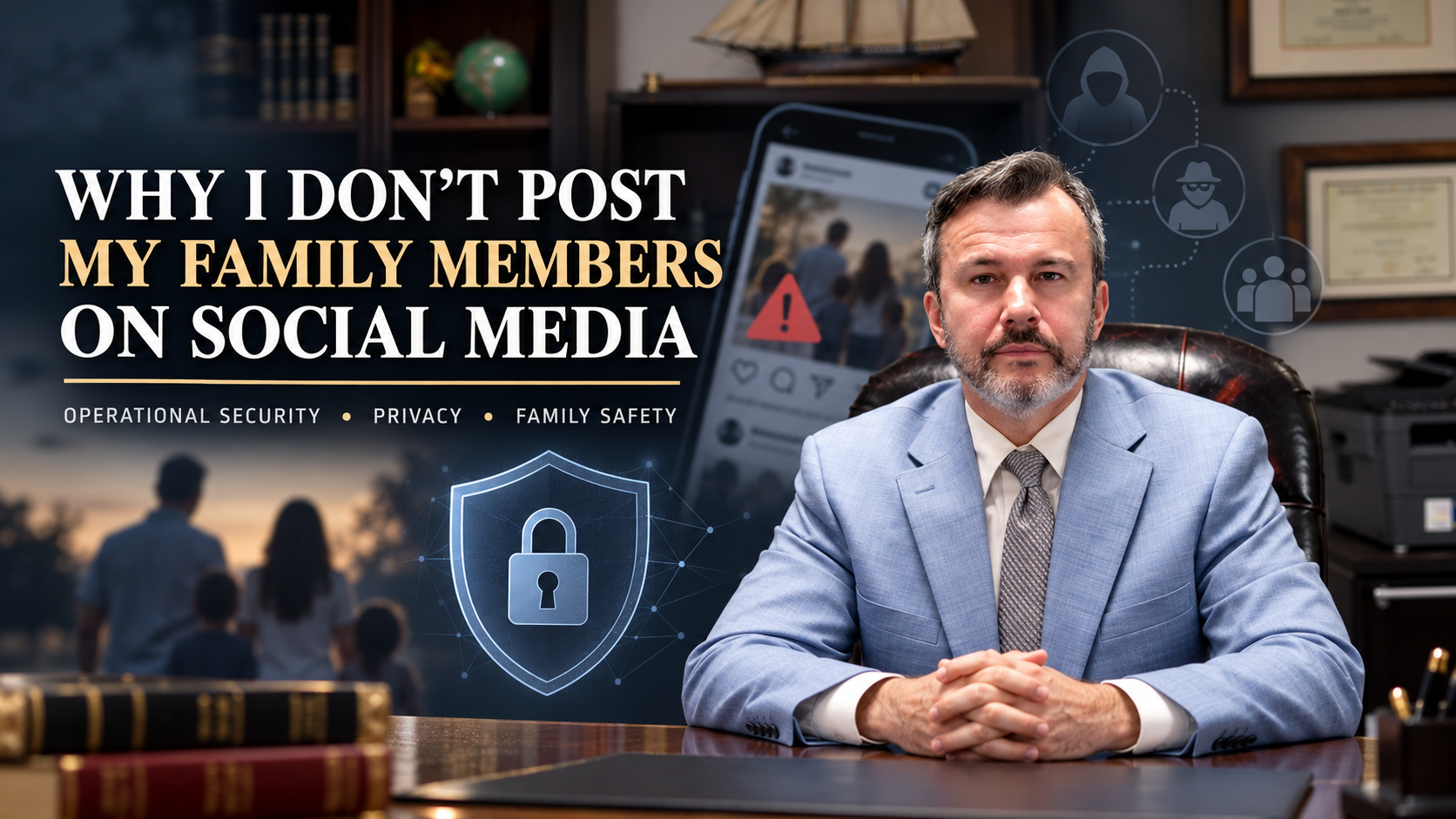
Why I Don’t Post My Family Members on Social Media
Hello everyone!
When I was teaching Information Security Management at UCLA Extension, one of the important subjects I covered was Operational Security (OPSEC). It is an essential component of information security that focuses on identifying and protecting sensitive information that could be exploited by individuals with malicious intentions.
Although OPSEC originated in military and intelligence operations, its principles are equally important in civilian life, particularly for attorneys, business owners, law enforcement professionals, and other individuals whose work may expose them to conflicts or threats.
Recently, I have noticed something that genuinely concerns me. I see attorneys openly posting photographs of their children on Facebook, Instagram, and other social media platforms. Some are single mothers who publicly share photographs of their children, identify their schools, and reveal details about their daily lives.
I understand why parents do this. They love their children and are proud of them. However, from an operational security perspective, publicly exposing your family members can put both them and you at risk.
In certain circumstances, it is almost like placing a target on yourself and your family.
Disgruntled Clients and Hostile Individuals
Attorneys work in an adversarial profession. We represent clients in immigration proceedings, criminal cases, divorces, business disputes, and other matters involving serious personal and financial consequences.
Not everyone is satisfied with the outcome of their case.
A disgruntled client may blame an attorney for losing a case, even when the attorney acted competently and professionally. An opposing party may develop hostility toward the lawyer representing the other side. Some individuals may become obsessive, aggressive, or threatening.
Most dissatisfied clients never resort to violence. Nevertheless, operational security requires us to consider what could happen when a genuinely dangerous individual gains access to personal information.
A hostile client may already know an attorney’s office address, professional schedule, and contact information. Public social media accounts can reveal something far more sensitive: the attorney’s family members, their identities, and their daily routines.
Imagine an attorney who regularly posts photographs of her children, identifies their school, shares extracurricular activities, and publicly announces family vacations.
Someone harboring a grudge could collect that information without ever contacting the attorney.
A person who wants to intimidate you may decide that threatening your family is more effective than threatening you directly.
This is precisely why family privacy should be considered part of professional risk management.
Organized Criminals and the Threat of Kidnapping
The risks are not limited to disgruntled clients.
Organized criminal groups may engage in kidnapping for ransom, extortion, intimidation, and other forms of targeted violence.
Professionals and business owners can become targets because criminals believe they have financial resources or access to money. Family members may also be targeted to pressure someone into paying a ransom or complying with demands.
You do not have to be a millionaire or exceptionally wealthy to become a target of kidnapping for ransom.
Upper-middle-class families, successful professionals, attorneys, physicians, and small business owners may also attract criminal attention.
What matters is not necessarily extraordinary wealth but the perception that someone has access to money, savings, property, credit, or relatives willing to pay for a loved one’s release.
A criminal does not need to believe that you are worth millions of dollars. It may be enough to believe that you could raise tens of thousands of dollars under pressure.
Social media can reinforce that perception. Photographs of expensive vehicles, luxury vacations, homes, and other indicators of financial success may attract unwanted attention, particularly when combined with information identifying family members.
You do not need to be rich to attract the attention of criminals. You only need to appear financially capable of paying a ransom.
Kidnapping for Ransom May Go Unreported
Another important consideration is that kidnapping for ransom is not always reported to law enforcement.
Families may be afraid that contacting the police could endanger the kidnapped person or provoke retaliation against other relatives.
Some criminal groups threaten victims’ families with serious consequences if they involve the authorities. In certain cases, ransom negotiations and payments may occur privately.
As a result, official statistics may not capture every kidnapping or extortion incident. The actual extent of underreporting is difficult to measure, and it varies considerably between countries and circumstances.
This is particularly relevant when dealing with organized criminal groups that use intimidation and threats of retaliation to discourage cooperation with law enforcement.
The absence of a police report does not necessarily mean that a crime never occurred.
Of course, most people who post family photographs will never experience kidnapping or targeted violence. But operational security is about reducing preventable vulnerabilities, particularly when the potential consequences are severe.
Why provide criminals with unnecessary information about your children, their schools, or their daily activities?
Social Media Privacy Is Often an Illusion
Some people believe their accounts are secure because only friends can see their posts.
Unfortunately, photographs can be copied, screenshotted, forwarded, and redistributed. Even trusted contacts can unintentionally disclose information through comments, tags, and reposts.
Deleting a photograph does not guarantee that it has disappeared.
One photograph may reveal very little. But dozens of posts can reveal where your children attend school, where your spouse works, which places your family regularly visits, and when your home might be unoccupied.
Even small details can become significant when combined with other publicly available information.
The danger often lies in the accumulation of information rather than any single disclosure.
This is exactly what operational security is designed to address.
Why I Don’t Post My Family Members on Social Media
Personally, I do not post photographs of my family members on social media.
This is a conscious decision based on my background in information security and my understanding of the potential risks associated with public exposure.
As an attorney, I maintain a public professional presence. I publish articles, discuss legal developments, participate in professional discussions, and share aspects of my work.
However, I draw a clear line between my professional activities and my family’s private life.
My clients and the general public may have legitimate reasons to know about my qualifications, legal experience, and professional activities.
They have no reason to know where my family members live, work, study, or spend their free time.
I do not believe professional success requires making your family part of your public image.
My decision is not based on fear of social media itself. It is based on a simple security principle: do not unnecessarily disclose information that could be used against you or the people you care about.
Basic Operational Security Rules
Protecting yourself and your family does not require abandoning social media. It requires making informed decisions about what information should remain private.
I recommend several practical precautions:
- Avoid posting identifiable photographs of minor children on public accounts, particularly professional profiles.
- Never publicly disclose children’s schools, regular schedules, or pickup arrangements.
- Avoid real-time location sharing, especially when traveling with family members.
- Separate professional and private social media accounts.
- Review photographs for identifying details, including addresses, school logos, license plates, and recognizable locations.
- Discuss privacy risks with family members, including relatives who may unintentionally reveal sensitive information.
- Review old posts and privacy settings to reduce unnecessary public exposure.
- Avoid publicly displaying unnecessary details about your financial situation, especially when those details can be connected to your family’s identities and locations.
- Take threats seriously, particularly when they involve family members. Preserve evidence and seek assistance from law enforcement when appropriate.
These measures cannot eliminate every risk, but they can reduce unnecessary exposure and make it more difficult for potentially hostile individuals to gather sensitive information.
Information Security Is Not Just About Computers
Many people associate cybersecurity exclusively with passwords, encryption, malware, and computer networks.
However, information security is much broader.
You can have excellent passwords, encrypted communications, sophisticated alarm systems, and surveillance cameras while simultaneously revealing sensitive information about your family to thousands of strangers online.
That is a serious contradiction.
The human factor is often one of the most significant vulnerabilities in any security system.
Operational security requires understanding how seemingly harmless information can be collected, analyzed, and potentially weaponized.
Before publishing something online, ask yourself a simple question:
Could this information help someone identify, locate, intimidate, extort, or harm me or a member of my family?
If the answer is yes, perhaps that information should remain private.
Conclusion
Social media encourages people to share increasingly personal details of their lives. But not everything needs to be public.
For attorneys and other professionals who may encounter hostile individuals, disgruntled clients, or organized criminal threats, maintaining boundaries between professional visibility and family privacy is particularly important.
You do not need to be a millionaire to become a potential target of extortion or kidnapping for ransom. A perception of financial stability, combined with publicly available information about your family, may create vulnerabilities that could otherwise have been avoided.
Your children do not need to become publicly identifiable simply because you have a professional social media presence.
Your family’s private life does not need to be part of your marketing strategy.
I choose not to expose my family members on social media because their privacy and safety are more important to me than likes, followers, or public attention.
Operational security is not paranoia. It is a practical approach to protecting yourself and the people closest to you.
Protect your information. Protect yourself. Protect your family.
Ernest Goodman,
Attorney.
This article is provided for general educational and informational purposes.
Ernest Goodman
Law Offices of Ernest GoodmanThis post discusses a publicly available court proceeding for informational purposes and does not constitute legal advice.
.