





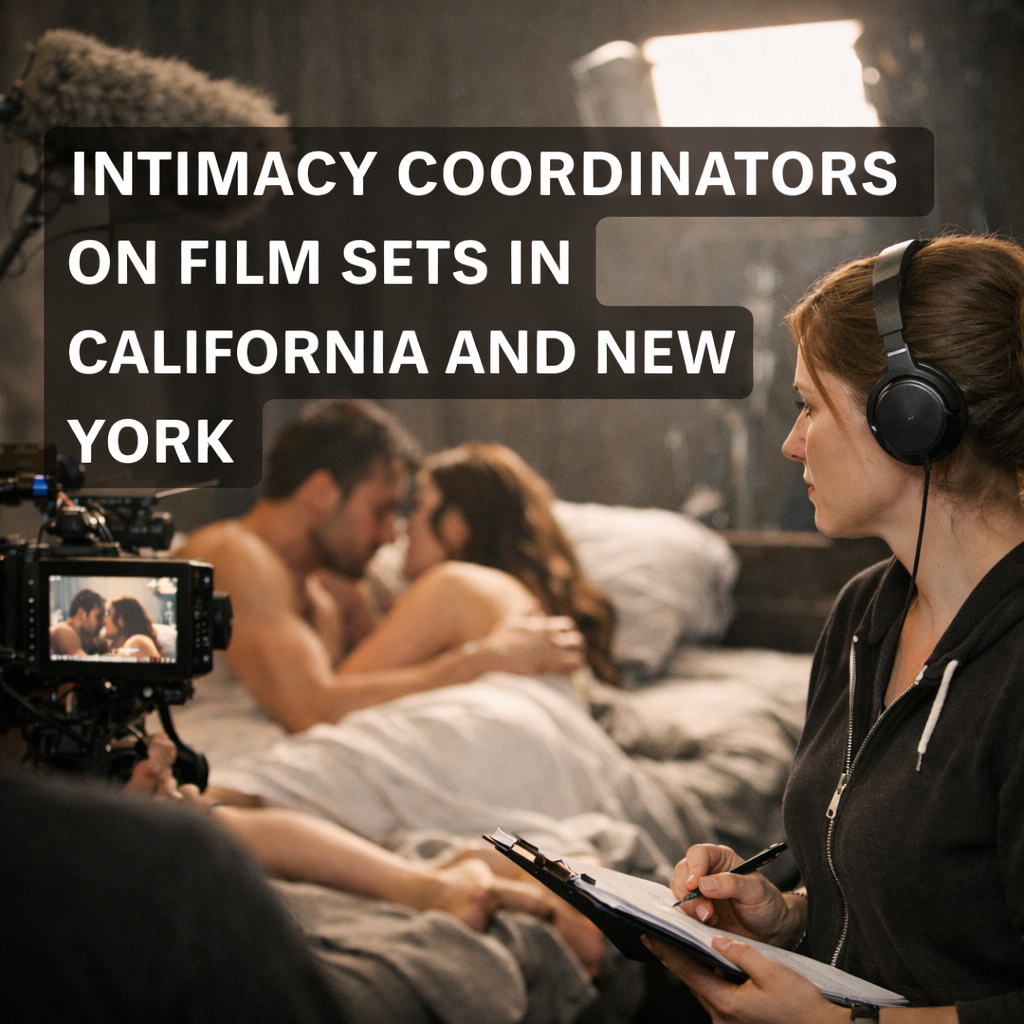
Intimacy Coordinators on Film Sets in California and New York
Consent, Contracts, Workplace Safety, and Liability in Modern Production
The use of intimacy coordinators on film and television sets has rapidly moved from a cultural innovation to an industry standard. In California and New York—the two legal centers of the American entertainment business—this role is no longer simply a matter of creative preference. It sits at the intersection of employment law, union compliance, tort liability, insurance coverage, and contract drafting.
For producers, the question is not whether a statute explicitly requires an intimacy coordinator. The real legal question is whether a production can safely film intimate scenes without one.
As with stunt coordination and child-performer protections, industry practice is in the process of becoming the legal standard of care.
I. The Legal Framework: There Is No Single Statute — There Is a System
Neither California nor New York has enacted a statute that expressly mandates the use of an intimacy coordinator. However, productions operate within a layered legal structure:
– SAG-AFTRA collective bargaining agreements
– state workplace-harassment laws
– negligence doctrine
– insurance underwriting requirements
– contract law governing performer consent
Once these sources are considered together, the presence of an intimacy coordinator becomes a risk-management function, not a creative luxury.
II. Union Compliance: SAG-AFTRA Standards as Binding Law on Set
SAG-AFTRA’s Standards and Protocols for the Use of Intimacy Coordinators require:
– advance disclosure of intimate content
– documented performer consent
– choreographed physical action
– closed-set procedures
– the right to withdraw consent before filming
On a union production, failure to follow these protocols is not merely bad practice. It is a contract violation.
Under SAG-AFTRA Codified Basic Agreement §43 (Nudity and Simulated Sex), performers must give prior written consent, and the employer must fully describe the material terms of the scene.
This transforms intimate performance into a compliance issue governed by labor law.
III. California Law: FEHA, Employer Liability, and the Duty to Prevent Harassment
California imposes some of the most expansive workplace-safety obligations in the United States.
Under the Fair Employment and Housing Act (Gov. Code §12940), employers have an affirmative duty to:
– prevent harassment
– take reasonable corrective action
– create a safe working environment
The California Supreme Court in State Dept. of Health Services v. Superior Court (McGinnis), 31 Cal.4th 1026 (2003) confirmed that employers may be held liable not only for harassment itself, but for failure to take all reasonable steps to prevent it.
An intimate scene filmed without structured consent procedures can be framed as:
– sexual harassment
– a hostile work environment
– failure to prevent harassment
In this context, the intimacy coordinator serves as evidence that the production implemented preventive compliance measures, which is critical in FEHA litigation.
California also imposes individual liability for harassment on supervisors (Gov. Code §12940(j)(3)), meaning directors and producers may face personal exposure if a scene is mishandled.
IV. New York Law: Human Rights Law and Strict Employer Responsibility
New York’s Human Rights Law (Executive Law §296) imposes strict liability on employers for harassment by supervisors.
After the 2019 amendments, New York eliminated the “severe or pervasive” standard for many workplace harassment claims. A performer no longer needs to show extreme misconduct—only that they were subjected to inferior terms, conditions, or privileges of employment.
This dramatically lowers the litigation threshold for on-set disputes.
In addition:
– nondisclosure agreements in harassment cases are restricted
– arbitration clauses are limited in enforceability
For productions, this means that poorly documented consent procedures are no longer defensible through contract drafting alone.
V. The Transformation of Consent in Performer Contracts
Traditional entertainment contracts treated consent to nudity as a fixed contractual promise.
That approach is no longer viable.
Under modern SAG-AFTRA practice, performers may withdraw consent before filming. The producer’s remedy is to:
– use a body double
– rewrite the scene
– restage the shot
This reflects a shift toward the doctrine recognized in:
Kameny v. Werner, 27 Cal.App.4th 1466 (1994) — which emphasized that consent obtained without full disclosure is legally defective.
A vague nudity rider now creates litigation exposure rather than protection.
VI. Tort Liability: The Emerging Standard of Care
Negligence law in both states asks a single question:
Did the defendant act as a reasonably prudent producer in the industry would under similar circumstances?
Industry custom is central to that analysis.
In Truman v. Vargas, 275 Cal.App.2d 976 (1969), the court held that industry practice is admissible to establish the standard of care.
The same principle applies in New York negligence law.
As intimacy coordinators become standard on major productions, the failure to use one will be framed as:
– foreseeable risk
– deviation from industry practice
– negligent supervision
This mirrors the evolution of stunt coordination in on-set injury litigation.
VII. Insurance and E&O Coverage
Entertainment insurers now examine intimate scenes as a defined risk category rather than a creative detail. They look closely at how specifically the nudity rider limits the performance, whether consent was documented as an ongoing process, and who had formal authority to supervise the scene on set. These elements signal whether the production exercised the kind of control and foresight that the insurance market associates with professional standards.
If that structure is missing, the issue often surfaces at the coverage stage. A carrier may argue that the claim falls within an employment-practices or intentional-conduct exclusion, or it may narrow its defense obligation and shift more cost back to the producer through higher deductibles. In practical terms, the policy that was supposed to protect the project becomes uncertain when it is most needed.
For financiers and completion guarantors, this makes the intimacy coordinator a financial safeguard as much as a workplace measure. A documented consent process supervised by a qualified professional demonstrates that foreseeable risk was managed according to industry practice, which helps preserve the reliability of the production’s insurance coverage.
VIII. Independent Film: The Personal Liability Trap
Non-union productions often assume they have greater flexibility.
Legally, they have greater exposure.
Without:
– union protocols
– standardized documentation
– trained third-party supervision
the producer personally becomes the decision-maker regarding:
– performer consent
– physical choreography
– workplace safety
In litigation, that concentration of authority supports claims for:
– coercion
– negligent supervision
– harassment
IX. Drafting Considerations for California and New York Productions
A modern nudity rider should:
– define the exact scope of exposure
– specify physical contact choreography
– include modesty garment requirements
– limit still photography and playback access
– address digital manipulation and AI use
– incorporate a consent-confirmation procedure immediately before filming
In California, the document must align with FEHA preventive-compliance obligations.
In New York, it must anticipate Human Rights Law litigation standards and insurance review.
X. Conclusion: From Best Practice to Legal Expectation
The intimacy coordinator is following the same legal trajectory as:
– stunt coordinators
– child-actor welfare teachers
– COVID compliance officers
What begins as a best practice becomes:
– union requirement
– insurance expectation
– evidence in litigation
– the standard of care
For producers in California and New York, the legal analysis is no longer theoretical.
The absence of structured intimacy protocols is not creative freedom.
It is a litigation strategy for the opposing side.
✍️ Written by Ernest Goodman, Entertainment & IP Law.
⚠️ Disclaimer by Ernest Goodman, Esq.
This article is intended for informational purposes only and does not constitute legal advice. Reading or relying on this content does not establish an attorney-client relationship. Because laws differ by jurisdiction and continue to evolve, readers are encouraged to consult a qualified attorney licensed in the relevant jurisdiction for advice tailored to specific circumstances.
.