




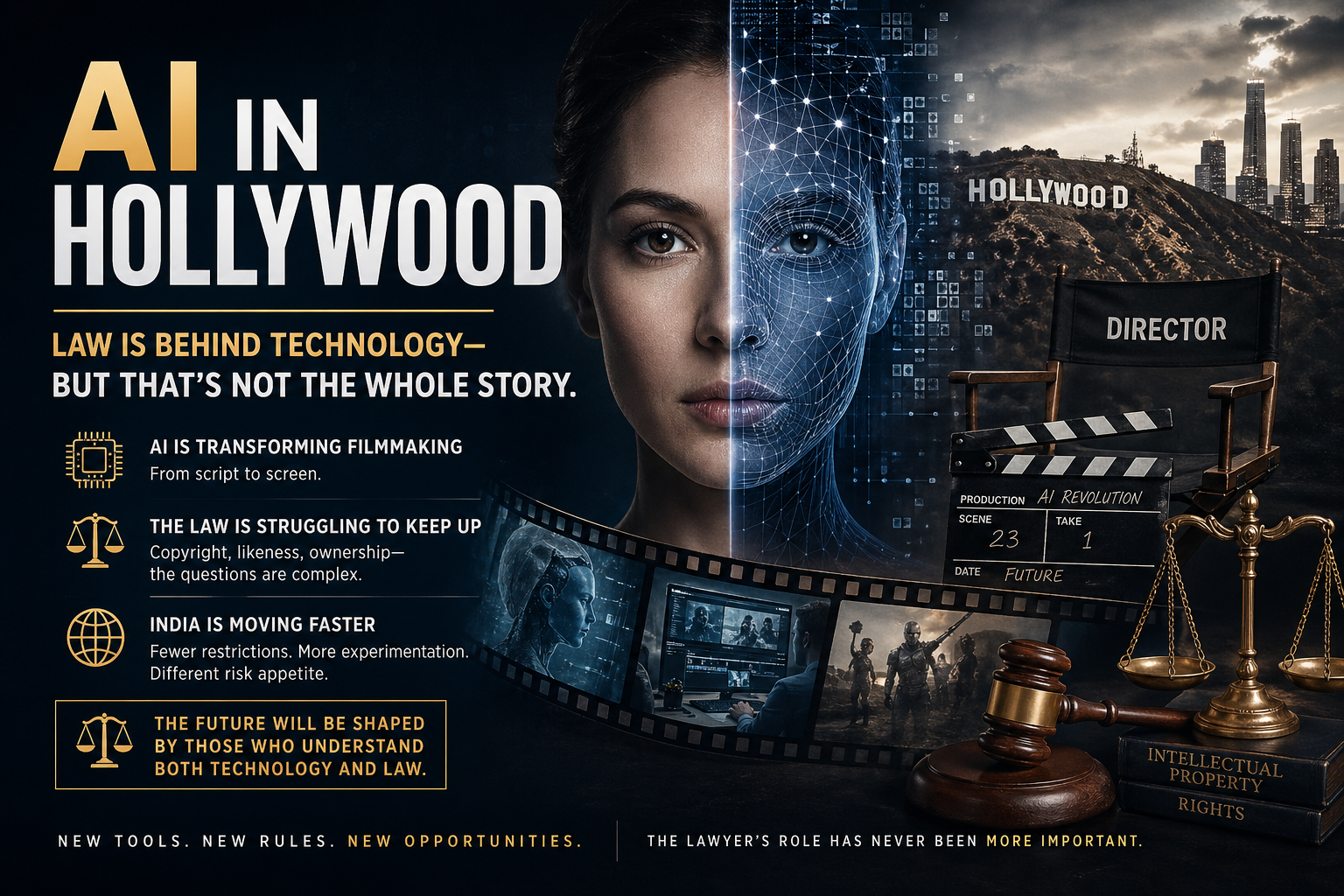
AI in Hollywood: Law Is Behind Technology
Hello everyone,
Today, we will talk about AI in film and media.
For years, people have repeated a simple idea: the law is five years behind technology.
In the age of artificial intelligence, that gap is no longer abstract. It is visible, measurable, and—most importantly—profitable for those who understand it.
Nowhere is this tension more obvious than in Hollywood.
Artificial intelligence is already embedded in the film industry. It is not theoretical. It is not “coming soon.” It is here. But its implementation is uneven, cautious, and often deliberately hidden behind traditional workflows. At the same time, other markets—particularly India—are moving faster, experimenting openly, and accepting risks that U.S. studios are unwilling to take.
To understand what is really happening, we need to separate myth from reality.
AI Is Already Inside Hollywood — Just Not Where You Expect
Major studios such as Netflix, Disney, and Warner Bros. Discovery are actively using AI—but not in the way the public imagines.
There are no fully AI-generated blockbuster films replacing actors and writers—at least not yet. Instead, AI has quietly taken over the infrastructure of filmmaking.
Visual effects departments rely on machine learning tools to generate environments, enhance scenes, and reduce manual labor. Crowd scenes that once required hundreds of extras can now be created with algorithmic simulation. De-aging technology has become so refined that audiences often cannot distinguish between real footage and digitally altered performances.
Post-production has changed even more dramatically. AI tools are now capable of assembling rough cuts, identifying optimal takes, and even generating trailers. What used to take weeks of human labor can now be reduced to days.
Localization is another area where AI is advancing rapidly. Studios are experimenting with dubbing systems that not only translate dialogue but also adjust lip movements to match the new language. This allows content to move globally with unprecedented efficiency.
Despite all of this, studios are careful about what they disclose. The reason is not technological limitation—it is legal exposure.
The Real Constraint: Contracts, Not Capability
The turning point for AI in Hollywood was not a technological breakthrough. It was labor resistance.
The strikes led by the Writers Guild of America and SAG-AFTRA forced studios to confront a fundamental question: who owns human creativity in the age of machines?
The outcome was not a ban on AI. Instead, it was a framework of restrictions.
Writers secured protections ensuring that AI cannot be credited as an author and cannot replace them as the primary creators of scripts. Actors negotiated strict controls over digital likenesses, requiring studios to obtain consent and provide compensation for any use of scanned or replicated performances.
Background actors—historically the most vulnerable—gained protections against being digitized and reused indefinitely without additional payment.
These agreements did not stop AI adoption. They reshaped it.
Studios can still use AI, but they must do so within contractual boundaries that preserve human participation. In practice, this means AI becomes an assistant rather than a replacement—at least on paper.
Copyright Law Is Struggling to Keep Up
Beyond contracts, the deeper issue lies in intellectual property law.
The U.S. Copyright Office has taken the position that purely AI-generated works are not eligible for copyright protection unless there is meaningful human authorship. This creates a paradox: AI can generate valuable content, but ownership of that content may be uncertain.
At the same time, lawsuits are emerging over the datasets used to train AI systems. Studios and technology companies face claims that copyrighted works were used without authorization to build models capable of generating new content.
Another unresolved area is the right of publicity. If an AI system can recreate an actor’s face, voice, or performance style, who controls that identity? In states like California, where publicity rights are strong, this question carries significant financial consequences.
Studios are not afraid of technology. They are afraid of ambiguity.
And ambiguity is everywhere.
Why India Is Moving Faster
While Hollywood moves carefully, industries like Bollywood are advancing more aggressively.
This is not because the technology is different. It is because the environment is different.
Union influence is significantly weaker, which reduces resistance to automation. Studios have more flexibility to experiment with AI tools without negotiating extensive labor protections.
Cost pressure also plays a critical role. AI offers a way to reduce production expenses dramatically, particularly in areas like visual effects and localization. For an industry producing a high volume of films across multiple languages, the incentive to adopt AI is immediate and practical.
Legal enforcement is another factor. The risk of large-scale litigation is lower, allowing companies to test new approaches without the same level of exposure faced by U.S. studios.
As a result, Indian filmmakers are integrating AI into workflows more openly, even if the legal framework remains underdeveloped.
They are building first and asking questions later.
The Real Divide: Risk Tolerance
The difference between Hollywood and India is not about access to technology. It is about tolerance for risk.
Hollywood operates in a high-stakes environment where a single lawsuit can cost millions and disrupt distribution. Every decision is filtered through layers of legal review, contractual obligations, and reputational concerns.
India operates in a more flexible system where experimentation is possible, even if the legal boundaries are not fully defined.
Both approaches have advantages. Hollywood preserves stability and protects talent. India accelerates innovation and reduces costs.
But over time, these paths will converge.
What Comes Next
Artificial intelligence will not replace filmmaking. It will redefine it.
Post-production will become increasingly automated, with AI handling tasks that were once considered highly specialized. Mid-budget films will rely heavily on AI-driven workflows to remain competitive.
Legal frameworks will eventually catch up. Licensing models for training data will emerge. Contracts will evolve to include detailed provisions governing digital likeness and AI-generated content.
And at some point, a major studio will release a film openly marketed as “AI-assisted,” signaling that the transition is complete.
Owning AI: The Next Frontier in Entertainment Law
For attorneys working at the intersection of intellectual property and entertainment law, this shift is not a threat. It is an opportunity.
Every AI-generated element raises questions of ownership, licensing, and liability. Every contract must now address issues that did not exist five years ago.
Who owns an AI-assisted screenplay?
Can an actor license their digital likeness separately from their physical performance?
What happens when AI-generated content incorporates elements of existing works?
These are not academic questions. They are already shaping deals, negotiations, and litigation.
The law may be behind technology. But that gap is where strategy lives.
And for those who understand both sides, it is where value is created.
✍️ Written by Ernest Goodman, US Immigration & IP Law.
⚠️ Disclaimer by Ernest Goodman, Esq.
This article is intended for informational purposes only and does not constitute legal advice. Reading or relying on this content does not establish an attorney-client relationship. Because laws differ by jurisdiction and continue to evolve, readers are encouraged to consult a qualified attorney licensed in the relevant jurisdiction for advice tailored to specific circumstances.
.