





Copyright vs. Trademark in Film Titles
Hello everyone!
Legal Protection of Movie Titles Under U.S., California, and New York Law
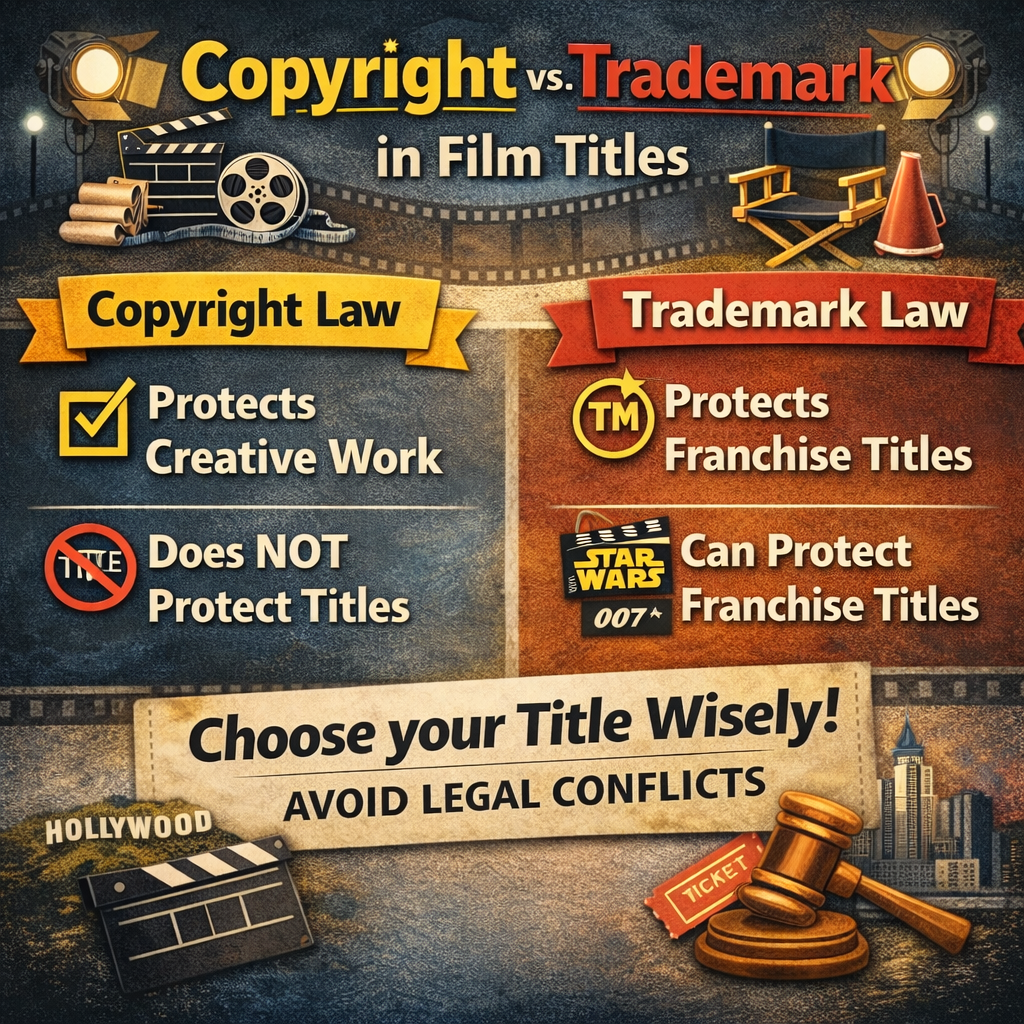
One of the most common misunderstandings among filmmakers is the belief that the title of a film is protected by copyright law.
In practice, this is almost never the case.
In the United States, the legal protection of film titles falls primarily under trademark law and unfair competition law, rather than copyright law. Understanding this distinction is important for filmmakers, producers, distributors, and anyone working in the entertainment industry.
Selecting a title for a film is not only a creative decision — it is also a legal and branding decision.
Copyright Law and Film Titles
Under the U.S. Copyright Act, copyright protection applies to original works of authorship fixed in a tangible medium of expression. Examples include:
– Screenplays
– Motion pictures
– Musical compositions
– Sound recordings
– Visual artwork
– Literary works
However, copyright law generally does not protect short phrases, including:
– Titles
– Names
– Slogans
– Brief expressions
The U.S. Copyright Office explicitly states in its regulations that words and short phrases such as names, titles, and slogans are not subject to copyright protection.
Relevant authority includes:
37 C.F.R. § 202.1(a)
This regulation clarifies that words and short phrases such as titles and slogans are not eligible for copyright protection.
The rationale behind this rule is straightforward: copyright law protects creative expression, not short identifying labels.
For example:
– The screenplay of a film is protected by copyright.
– The film itself is protected by copyright.
– The dialogue, music, and visual imagery are protected by copyright.
But the title of the film alone usually cannot qualify as a copyrightable work.
Trademark Law and Film Titles
Because copyright protection is unavailable for most film titles, legal protection typically arises through trademark law.
Trademark law protects words, names, symbols, or phrases used to identify the source of goods or services and to distinguish them from competitors.
In the entertainment industry, trademarks are often used to protect film franchises, television series, and entertainment brands.
Examples include:
– Star Wars
– James Bond
– Mission: Impossible
– Fast & Furious
– Harry Potter
These titles function not merely as names of individual works, but as brands associated with a continuing series of films and related products.
As a result, they can receive protection under the Lanham Act, the federal trademark statute.
Relevant provision:
15 U.S.C. § 1125(a) (Lanham Act – False Designation of Origin)
This section protects against the use of names or designations that may cause consumer confusion regarding the source of goods or services.
The “Single Work Title” Rule
A key principle in U.S. trademark law is the single-work title rule.
Under this rule, the title of a single creative work generally cannot function as a trademark, because it does not identify the source of multiple goods or services.
For example:
A film titled Midnight Horizon released as a single movie would typically not qualify for trademark protection as a standalone title.
However, if the film later becomes a series or franchise, the title may acquire trademark significance.
For example:
– Rocky began as a single film but later became a long-running franchise.
– Star Wars evolved into a massive entertainment brand including films, television series, merchandise, and theme park attractions.
Once a title identifies a continuing source of entertainment products, it may qualify for trademark registration and protection.
Industry Practice: Title Clearance and Registration
Because many film titles cannot rely on copyright or trademark protection alone, the entertainment industry has developed private systems to manage title conflicts.
One of the most important is the Motion Picture Association Title Registration Bureau (TRB).
Major studios register film titles with the TRB to reduce the risk of confusingly similar titles being used by competing productions.
Although TRB registration does not create a federal trademark, it functions as an industry-wide clearance mechanism.
Independent filmmakers also commonly perform title clearance searches to determine whether their proposed title may conflict with existing films, television programs, or trademarks.
Failure to perform title clearance can create serious problems later in the distribution process, including:
– Distributor rejection
– Insurance issues (Errors & Omissions insurance)
– Potential litigation
California Law and Film Title Protection
Because the American film industry is heavily concentrated in California, many disputes involving film titles arise under California law.
California protects titles primarily through unfair competition law and trademark principles.
California Unfair Competition Law
Relevant statute:
California Business and Professions Code §17200
This provision broadly prohibits unfair competition and deceptive business practices, including business conduct that may mislead consumers.
In the context of film titles, this statute may apply if:
– A film uses a title confusingly similar to an existing production
– The title creates the false impression that the film is associated with another well-known project
– The title misappropriates the reputation or goodwill of another production
California courts frequently analyze title disputes through the lens of consumer confusion, which is a central concept in trademark law.
First Amendment Considerations
California courts also recognize that film titles are part of expressive works, which are protected under the First Amendment.
As a result, courts often apply the Rogers test, a legal standard derived from federal case law.
Under the Rogers test, the use of a title in an expressive work is generally permitted unless:
-
The title has no artistic relevance to the underlying work, or
-
The title explicitly misleads consumers about the source of the work.
This balancing test allows filmmakers to retain creative freedom while preventing deceptive practices.
New York Law and Film Titles
New York, another major center of media and entertainment, approaches title protection in a similar way.
New York law relies primarily on trademark principles and unfair competition doctrine.
New York General Business Law
Relevant statute:
New York General Business Law §349
This statute prohibits deceptive acts and practices in the conduct of business.
If a film title is used in a way that misleads consumers about the origin of a film or falsely suggests association with another project, a claim may arise under this provision.
Common Law Unfair Competition
New York courts also recognize a broad doctrine of common law unfair competition, which protects businesses from the misappropriation of their goodwill.
In film title disputes, courts may consider whether:
– A new film title intentionally imitates an existing title
– The imitation is designed to exploit the reputation of another film
– The similarity creates a likelihood of consumer confusion
New York courts sometimes refer to this doctrine as protection against misappropriation of commercial advantage.
Because New York is a major hub for film distribution, publishing, and media companies, many title disputes involving marketing or distribution may arise in federal courts within the Second Circuit.
Practical Considerations for Filmmakers
From a legal perspective, film titles exist at the intersection of several areas of law:
1. Copyright Law
Copyright protects the creative content of the film, including the screenplay, visual imagery, music, and editing.
However, copyright usually does not protect the title.
2. Trademark Law
Trademark law may protect titles that function as identifiers of a brand or series.
Franchises and entertainment brands often rely heavily on trademark protection.
3. State Unfair Competition Law
State statutes in jurisdictions such as California and New York may prevent confusing or deceptive use of titles, even when formal trademark protection is unavailable.
Conclusion
Film titles occupy a unique position in the legal landscape of the entertainment industry.
Although titles are not typically protected by copyright law, they may receive protection through:
– Trademark law
– Industry title registration systems
– State unfair competition statutes
– Common law doctrines protecting commercial goodwill
For filmmakers, choosing a title should involve more than creative considerations. It should also include title clearance, trademark analysis, and legal review.
A strong title can become one of the most valuable assets of a film — especially if the project evolves into a successful franchise or entertainment brand.
✍️ Written by Ernest Goodman, US Immigration & IP Law.
⚠️ Disclaimer by Ernest Goodman, Esq.
This article is intended for informational purposes only and does not constitute legal advice. Reading or relying on this content does not establish an attorney-client relationship. Because laws differ by jurisdiction and continue to evolve, readers are encouraged to consult a qualified attorney licensed in the relevant jurisdiction for advice tailored to specific circumstances.
.