





How People Pretend to Be Bigger Than They Are in the Film Industry
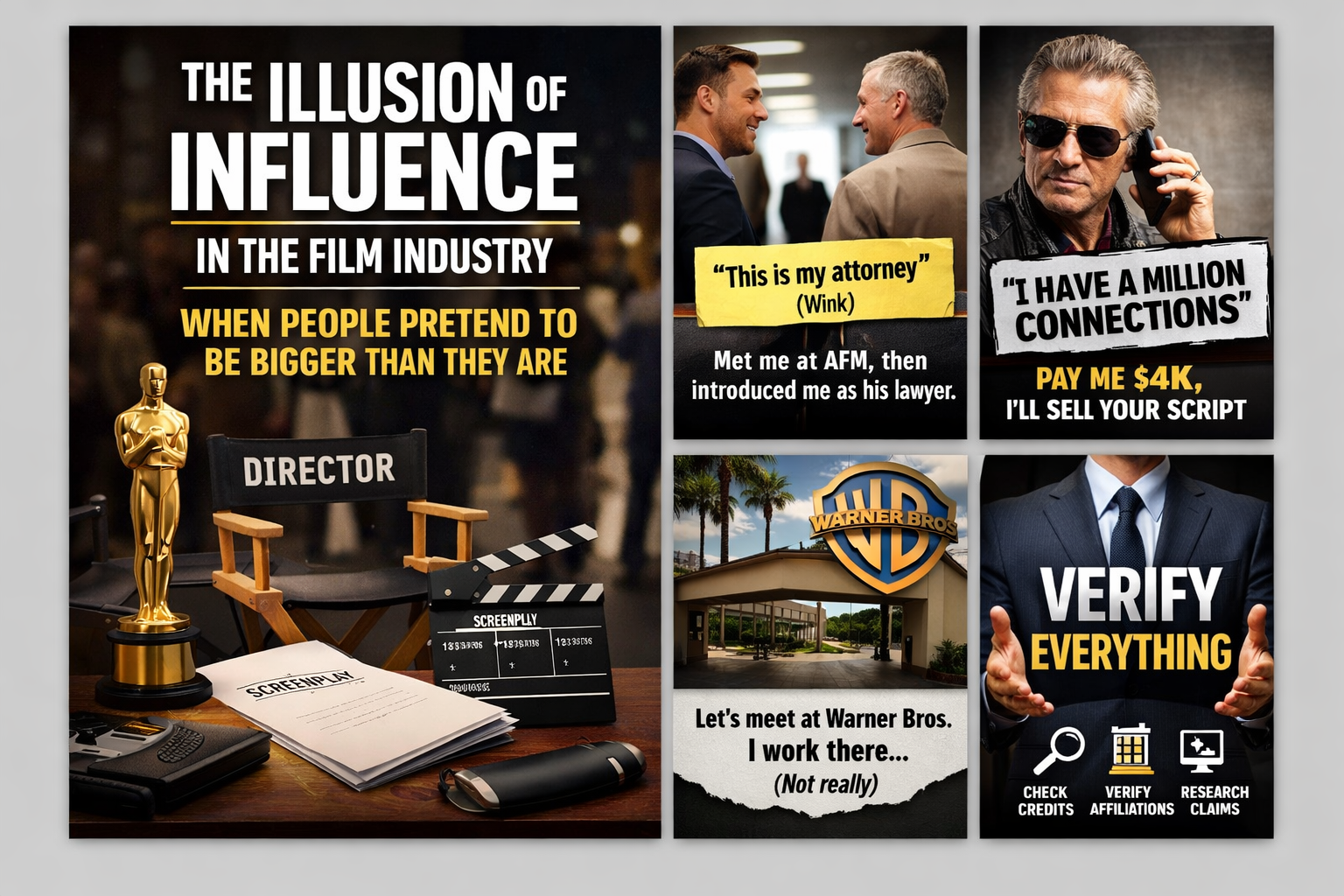
The film industry runs on perception. Reputation, access, and relationships often matter just as much as talent. But this creates a predictable side effect—an environment where some individuals build not real influence, but the illusion of it.
Over time, especially through real experience at markets and festivals, you begin to recognize a pattern: people who try to appear bigger than they are by attaching themselves to others, exaggerating their reach, and using environments that look impressive.
I’ve encountered this repeatedly—and in different forms.
“My Attorney” — When Your Name Gets Used Without Permission
This is not hypothetical. This actually happened.
At the American Film Market (AFM-25), I was visiting offices, meeting people, and networking.
In a hallway, I met a person briefly. He asked who I was. I introduced myself as an IP and entertainment attorney and gave him my business card. That was the entire interaction.
A short time later, we entered an office where he had a meeting. Without any discussion, without any relationship, he introduced me as:
“This is my attorney.”
Then he winked.
There was:
– No agreement
– No authorization
– No professional relationship
Just an attempt to instantly elevate his status by attaching mine.
But what stood out even more was what followed. This wasn’t just a one-off comment. It reflected a broader behavior—an attempt to pull me into his narrative as if I were part of his professional structure.
In environments like AFM, credibility is often decided in seconds. Saying “this is my attorney” signals legitimacy, organization, and seriousness. It changes how others perceive you immediately.
And that is exactly why this tactic is used.
The “Million Connections” Operator
Another category is more deliberate—and more harmful.
There are individuals who present themselves as insiders with unlimited reach:
“I have a million connections.”
From my experience, these individuals often:
– Had minor involvement in the industry years ago
– Have a few outdated or insignificant credits
– Speak in vague, unverifiable claims
They position themselves as gatekeepers—people who can “open doors.”
They approach young filmmakers and offer:
– Script promotion
– Investor access
– Packaging services
– “Industry introductions”
Usually for $2,000 to $4,000.
What actually happens is very different.
In one case I observed closely, scripts were supposedly being sent out to industry contacts. But those contacts could not be verified. Names sounded impressive, but did not lead anywhere. There was never any documentation showing who received the material or how it was evaluated.
The result, however, was always consistent:
“They passed.”
No explanation. No feedback. No trace of real activity.
At the same time, this individual was actively building an image around himself—and part of that image included me.
He would tell his clients:
“I have an entertainment lawyer in my team.”
That phrasing is carefully chosen. It suggests structure. It suggests legitimacy. It suggests that behind him there is a real operation with legal support.
But in reality, there was no such relationship.
No agreement. No authorization. No involvement.
Just an attempt to expand his perceived importance by attaching a real professional to his story.
And to be clear—having real connections is a good thing. My professional status and network are built through actual work, real clients, and real responsibilities. That is precisely why it gets used by others.
I had to explain directly to those filmmakers that I was not affiliated with him, not part of any team, and that I only provide services through formal engagement. For many of them, that was the moment when things stopped adding up.
The Warner Bros. Illusion
Another variation is what can be called location-based credibility.
I encountered an individual who worked gig-to-gig helping with festivals and industry events. This individual had some credits, but nothing that would support the level of authority being claimed. Still, the way they presented themselves was very different—they positioned themselves as a producer working with Warner Bros..
The strategy relied almost entirely on environment.
Meetings were scheduled at Warner Bros. locations. Publicly accessible areas were used in a way that created the impression of internal access. The individual would arrive from inside the building, walk confidently into meetings, and speak as if they were part of the organization.
To someone new to the industry, this is extremely convincing.
It feels like proximity to power. It looks like access. It creates the impression that doors are open.
But in reality, it is a carefully constructed illusion. Being physically present in a location is not the same as having influence within it.
What made the situation more concerning was that the same pattern repeated again—this individual would introduce me as a professional contact, refer people to me, and use that association to reinforce their own credibility.
At that point, it becomes clear that the goal is not just self-presentation. The goal is to build an expanded identity using other people’s reputations.
What Is a Vanity Credit?
This is where an important clarification is needed.
A vanity credit is a title that does not necessarily reflect meaningful involvement in a project. It may be loosely assigned, self-presented, or granted without significant responsibility behind it. Titles like “Executive Producer” or “Producer” can sometimes fall into this category when they are used more for appearance than for actual function.
That said, there is nothing inherently wrong with vanity credits.
They exist throughout the industry. They can serve branding purposes, help individuals position themselves, or reflect informal contributions that are not strictly defined. In many cases, they are simply part of how the industry operates.
The issue begins when those credits are used as a foundation for claims that go beyond reality. When a title becomes a tool to suggest authority, access, or influence that does not actually exist—especially in situations involving money or representation—it crosses into misrepresentation.
A title alone does not create capability. And it certainly does not guarantee access.
The Pattern: Expanding Yourself Through Others
Looking at all these situations together, a clear pattern emerges.
It is not just about exaggeration. It is about construction.
These individuals build a version of themselves that appears larger, more connected, and more established than reality. And they do it by layering elements—titles, locations, vague claims, and most importantly, other people.
They don’t just say they are connected. They show it by attaching real professionals, even without permission. They don’t just claim access. They place themselves in environments that imply it. They don’t just talk about opportunities. They position themselves as the gateway to them.
And in the process, they try to involve you—even when you never agreed to be involved.
Why This Works
This behavior persists because the industry allows it.
There is very little standardization in titles. Verification is rarely immediate. People are constantly looking for access, and when something looks legitimate, they tend to accept it at face value.
Social proof fills the gaps.
If someone appears connected, most people assume they are.
The Cost
For filmmakers, especially those starting out, the cost is often underestimated.
It is not just the money spent on empty promises. It is the time lost pursuing the wrong path. It is the delay in finding real collaborators. It is the false sense of progress that ultimately leads nowhere.
And for professionals, there is a different kind of cost.
When your name is used without your consent, you are pulled into situations you never agreed to. You may be perceived as part of operations you have no connection to. And you are forced to spend time correcting misunderstandings instead of focusing on actual work.
A Practical Approach: Verify Everything
Because of my background in law and information security, I approach these situations differently.
I verify.
Even basic open-source research can reveal whether someone’s claims align with reality. Credits can be checked. Affiliations can be traced. Patterns of behavior can be identified.
If someone claims to have widespread industry connections, there should be something concrete behind that claim.
If there isn’t, that absence is meaningful.
Final Thought
The film industry rewards perception—but perception alone is not substance.
There is a difference between building a real reputation and constructing an image that depends on others.
Some people grow their careers through work, consistency, and real relationships.
Others grow their image by attaching themselves to those who already have one.
Understanding that difference is not just helpful—it is essential.
✍️ Written by Ernest Goodman, US Immigration & IP Law.
⚠️ Disclaimer by Ernest Goodman, Esq.
This article is intended for informational purposes only and does not constitute legal advice. Reading or relying on this content does not establish an attorney-client relationship. Because laws differ by jurisdiction and continue to evolve, readers are encouraged to consult a qualified attorney licensed in the relevant jurisdiction for advice tailored to specific circumstances. Ernest Goodman is a lawyer licensed in the State of New York.
.