





⚖️ The Use of Your Legal Name as a Trademark
Hello everyone,
Today we will talk about the use of your legal name as a trademark.
Many professionals instinctively believe that their legal name belongs entirely to them in every context, including business. It feels natural to assume that if you are born with a name, you have the unrestricted right to use it commercially. However, trademark law operates on a very different principle.
Your legal name does not automatically grant you exclusive rights in the marketplace. It does not guarantee trademark protection, and in certain situations, you may even be restricted from using it in connection with your own business. This disconnect between intuition and legal reality is where many costly mistakes begin.
Trademark law is not concerned with personal identity. It is concerned with how names function in commerce and how they are perceived by the public. If you approach your name as a personal right rather than a business asset, you risk losing control over it at the very moment you begin to rely on it professionally.
⚖️ Trademark law protects perception, not identity
At its core, trademark law is built around consumer perception. The legal system does not ask whether a name belongs to you. Instead, it asks whether that name identifies the source of goods or services in the minds of consumers.
This distinction is subtle but fundamental. A name used casually or personally has no trademark significance. The same name, when used consistently in business, can evolve into a commercial identifier. Once that shift occurs, the name enters the domain of trademark law, where different rules apply.
A personal name becomes legally relevant only when it signals to the public that a particular product or service originates from a specific source. In that moment, your name stops being just your identity and begins functioning as a brand.
⚠️ Why personal names are weak trademarks at the outset
Under U.S. trademark law, personal names are not considered inherently distinctive. They are often categorized as surnames or descriptive identifiers, which means they do not immediately qualify for strong protection.
This reflects a practical reality. Many individuals share the same name, and the law is designed to prevent one person from monopolizing a common identifier without sufficient justification. As a result, your name begins its life as a legally weak mark.
This does not mean your name cannot be protected. It means that protection must be earned through use, recognition, and market presence. Until that happens, your rights are limited and potentially vulnerable.
📈 Secondary meaning: the transformation from identity to brand
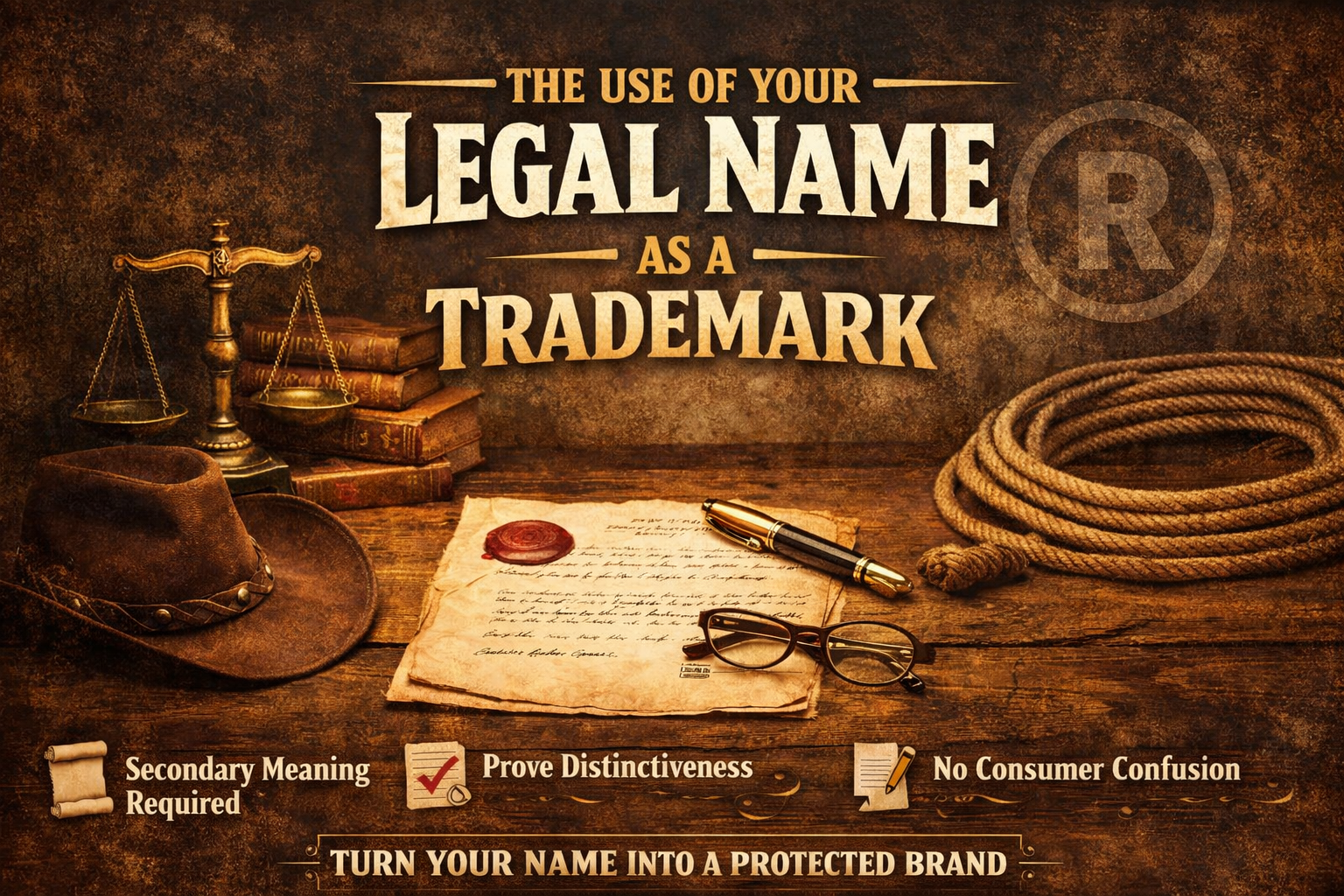
The key concept that determines whether your name can function as a trademark is secondary meaning. This concept represents a turning point where your name acquires a new commercial significance.
Secondary meaning exists when the public no longer sees your name as merely identifying a person, but instead associates it with a particular business or service. This shift does not occur automatically. It develops over time through consistent use, exposure, and reputation.
As your name becomes more visible in the marketplace, clients and consumers begin to connect it with a specific type of service or product. Eventually, the name itself carries independent value. It signals quality, reliability, or a particular style. At that point, your name has become a brand in the legal sense.
🌟 From personal name to commercial identity
The evolution of a name into a trademark is not theoretical. It has occurred repeatedly in business and culture. Figures such as Ralph Lauren and Calvin Klein built global brands using their personal names, but their success was not based on the names alone.
What made those names powerful was consistent use, disciplined branding, and sustained public recognition. Over time, the names ceased to function merely as personal identifiers. They became symbols of a particular category of goods, associated with a defined standard and reputation.
This is the path any professional must follow if they intend to turn their legal name into a meaningful business asset.
⚖️ The “own name” principle: a narrow and misunderstood doctrine
There is a widely repeated idea that a person always has the right to use their own name in business, regardless of existing trademarks. While this notion has some basis in law, it is often misunderstood and overstated.
Trademark law does recognize a limited principle sometimes referred to as the “own name” or fair use doctrine. This principle allows individuals to use their legal names in commerce under certain circumstances. However, it is not an absolute right, and it does not override the fundamental rules of trademark law.
The most important limitation is the prohibition against consumer confusion. If the use of your name creates a likelihood that consumers will mistake your business for another, your right to use that name may be restricted or even prohibited.
This means that your legal identity does not give you permission to operate in a way that disrupts the clarity of the marketplace.
⚠️ The central limitation: likelihood of confusion
The concept of likelihood of confusion is the cornerstone of trademark law. It governs nearly every dispute involving names, brands, and commercial identity.
Confusion does not require intentional deception. It is enough that an ordinary consumer might reasonably believe that two businesses are connected, affiliated, or related. This can occur when names are similar, when branding overlaps, or when companies operate in the same field.
If your use of your own name creates that kind of confusion, the law will intervene. Courts have the authority to limit how you use your name, require modifications, or in some cases prohibit its use in a particular market altogether.
This outcome often surprises individuals who assume that their personal identity will protect them. In reality, trademark law prioritizes the clarity of the marketplace over individual preference.
⚠️ Practical risks of using your name without a strategy
Using your legal name in business without careful planning can create a range of problems. Conflicts may arise with other individuals or companies who share the same or similar name but have established prior rights. In trademark law, priority is determined by use in commerce, not by personal ownership of the name.
Even if no immediate conflict exists, a name that lacks distinctiveness may be difficult to enforce. This can leave you unable to prevent competitors from using similar branding, weakening your position over time.
In more serious situations, you may face legal challenges, including cease-and-desist demands, despite using your own name. These disputes can lead to costly rebranding efforts, disruption of business operations, and damage to professional reputation.
Beyond legal risk, there is also a strategic concern. A poorly developed name-based brand may fail to convey credibility, limit your ability to form partnerships, and reduce the long-term value of your business.
🎯 Strategy as the foundation of protection
Trademark protection does not begin with filing an application. It begins with a clear understanding of how your name will function in the marketplace.
A proper strategy involves evaluating potential conflicts, defining the scope of your services, and determining how your name will be presented to the public. In some cases, it may be necessary to enhance your name with additional elements, such as descriptive wording or a distinctive visual identity, in order to strengthen its legal position.
Consistency is critical. The more uniformly your name is used across platforms and contexts, the more likely it is to develop the recognition required for protection. Over time, this consistent use builds the foundation for secondary meaning and enforceable rights.
🧭 Building a defensible and valuable name-based brand
If approached correctly, a legal name can become one of the most valuable assets in a professional’s portfolio. The process requires deliberate effort, sustained visibility, and careful control over how the name is used in public.
As your reputation grows and your name becomes associated with a particular type of service or quality, it gains independent commercial value. Clients begin to rely on it as a signal of trust. At that point, your name is no longer just a personal identifier. It is a brand with legal significance.
This transformation does not happen by chance. It is the result of consistent use, strategic positioning, and an understanding of how trademark law operates.
⚖️ Conclusion
You can use your legal name as a trademark to identify goods or services, but federal registration requires proving the name has acquired distinctiveness (secondary meaning) and is not merely a surname. The USPTO requires written consent to register a living person’s name. It must not cause confusion with existing marks or falsely suggest a connection to a specific, recognized person.
Your legal name is a powerful starting point, but it is not a guarantee of protection. In trademark law, the question is not whether the name belongs to you. The question is what that name represents to the public.
And even under the “own name” principle, one rule always prevails:
Your rights end where consumer confusion begins.
✍️ Written by Ernest Goodman, US Immigration & IP Law.
⚠️ Disclaimer by Ernest Goodman, Esq.
This article is intended for informational purposes only and does not constitute legal advice. Reading or relying on this content does not establish an attorney-client relationship. Because laws differ by jurisdiction and continue to evolve, readers are encouraged to consult a qualified attorney licensed in the relevant jurisdiction for advice tailored to specific circumstances.
.