





Cheap Trademark Filing vs. Real Trademark Strategy
Hello everyone,
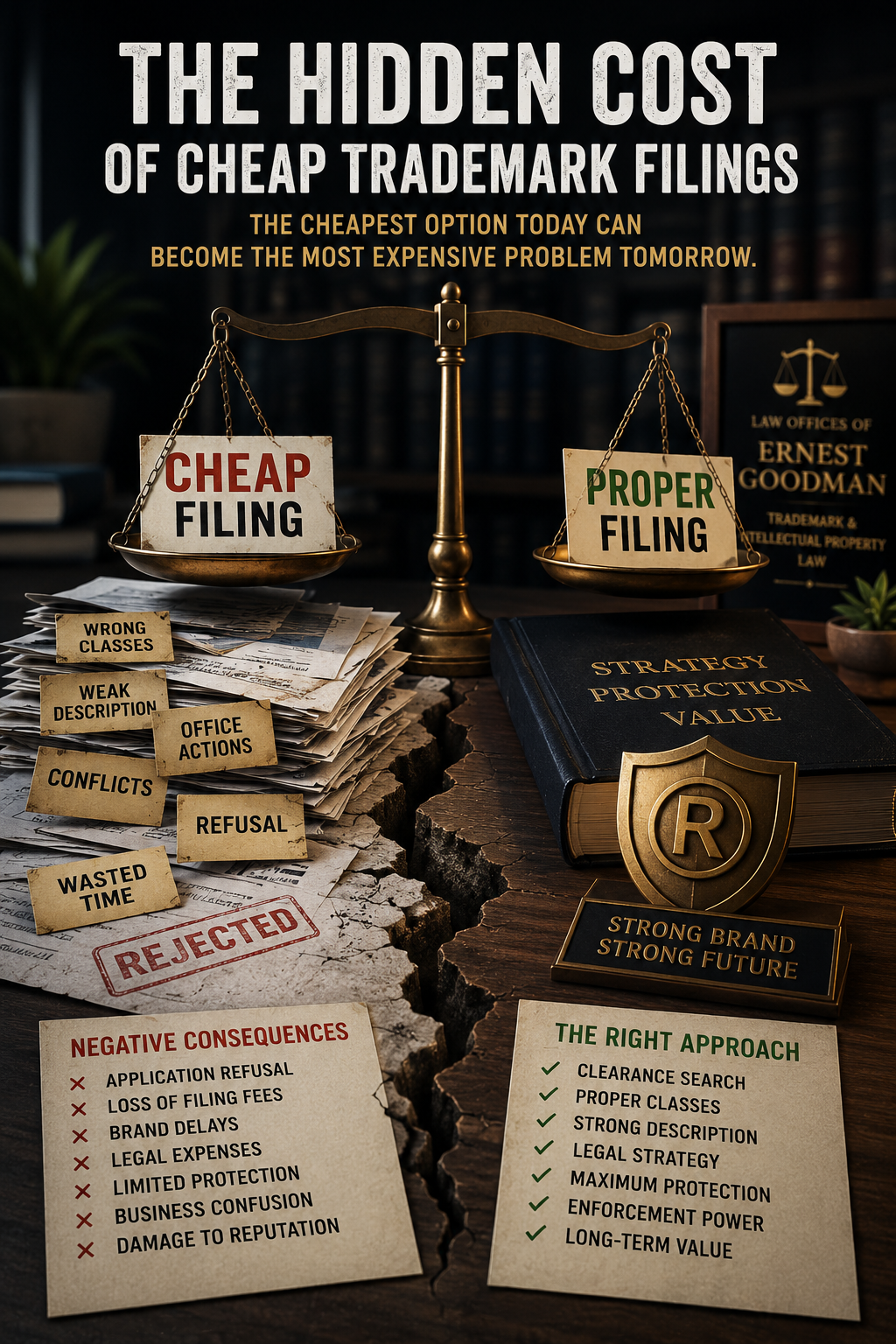
Today, we will talk about the consequences of using cheap trademark filing services.
In today’s online world, many businesses look for the fastest and cheapest way to file a trademark application. At first glance, this seems reasonable. A trademark filing may appear to be simple paperwork: fill out a form, pay a fee, and wait for approval.
In reality, trademark law is much more strategic than many people realize.
A trademark is not just a logo or a name. It is part of the identity of a business. It can become one of the company’s most valuable assets. A strong trademark protects reputation, branding, customer recognition, online presence, and long-term growth.
The problem is that many “cheap filing” services focus only on submitting an application. They often do not evaluate whether the mark is actually protectable, whether it conflicts with existing trademarks, or whether the chosen filing strategy creates future legal problems.
As a result, business owners sometimes spend years building a brand around a trademark that was weak from the beginning.
One of the most common problems involves clearance searches. A business owner may believe a name is available because a domain name exists or because social media accounts are open. However, trademark conflicts are more complicated than simple internet searches. A mark may conflict with existing federal registrations, pending applications, common-law trademarks, or businesses operating in related industries.
Trademark likelihood of confusion analysis is also much more fluid than many business owners expect.
Your trademark does not have to be identical to an existing registered trademark to be refused. The USPTO may refuse registration if the examining attorney believes consumers are likely to be confused about the source of the goods or services.
This analysis is based on the well-known DuPont factors. These factors include, among other things, the similarity of the marks, the similarity of the goods or services, the channels of trade, the classes of consumers, the strength of the prior mark, and other circumstances that may affect consumer confusion.
Because the factors are flexible, there is no simple formula. Sometimes marks that look somewhat different may still be refused if the goods or services are closely related. In other situations, similar wording may coexist if the commercial impressions, goods, services, or marketplace conditions are sufficiently different.
That is why a proper trademark search is not just about finding identical names. It is about evaluating legal risk. A search should look for similar marks, related goods and services, related industries, and possible arguments that the USPTO may raise during examination.
This problem never gets old because I continue to see it in real practice.
One of my clients once refused a full trademark clearance search before filing. I explained the risk, disclosed the limitation, and our agreement clearly stated that we would not be responsible for conflicts that a proper search could have revealed because no search had been performed.
The client decided to proceed anyway.
During examination, the trademark examiner found a similar trademark. A full search likely would have revealed this issue before filing. Now the client is facing a refusal and a TTAB-related problem that could have been addressed much earlier with a proper search and strategy.
Another major issue involves the selection of trademark classes and descriptions of goods or services. Many low-cost filing services use overly broad or generic descriptions without considering how the business actually operates. Others select incorrect classes entirely. These mistakes may create problems during examination before the United States Patent and Trademark Office or limit the value of the registration later.
Businesses also underestimate how often trademark applications receive Office Actions from the USPTO. These are official refusals or requests for clarification issued by trademark examining attorneys. Some Office Actions are relatively simple, but others involve complex legal issues:
- likelihood of confusion refusals;
- descriptiveness refusals;
- specimen problems;
- identification issues;
- disclaimers;
- questions involving foreign registrations and the Madrid System.
At that point, a “cheap filing” suddenly becomes expensive because the business owner now needs legal assistance to save the application.
International expansion creates additional risks. Many companies eventually want to expand outside the United States through the World Intellectual Property Organization Madrid System. However, if the original U.S. application was poorly drafted, overly narrow, or strategically flawed, those problems may affect the international filing as well.
There is also an enforcement problem. Some trademarks technically obtain registration but are so weak or narrowly drafted that they provide little practical protection. A registration certificate alone does not automatically create a strong trademark. The quality of the filing strategy matters.
This does not mean every trademark filing must be extremely expensive or overly complicated. But businesses should understand that trademark law is not simply data entry. A proper filing involves legal analysis, branding strategy, risk evaluation, and long-term planning.
The cheapest option at the beginning is not always the least expensive outcome later.
A trademark should help protect a business as it grows — not become a legal obstacle that must be repaired years later.
✍️ Written by Ernest Goodman, US Immigration & IP Law.
⚠️ Disclaimer by Ernest Goodman, Esq.
This article is intended for informational purposes only and does not constitute legal advice. Reading or relying on this content does not establish an attorney-client relationship. Because laws differ by jurisdiction and continue to evolve, readers are encouraged to consult a qualified attorney licensed in the relevant jurisdiction for advice tailored to specific circumstances.
.