





Motion to Enforce Habeas Corpus in Immigration Detention Cases
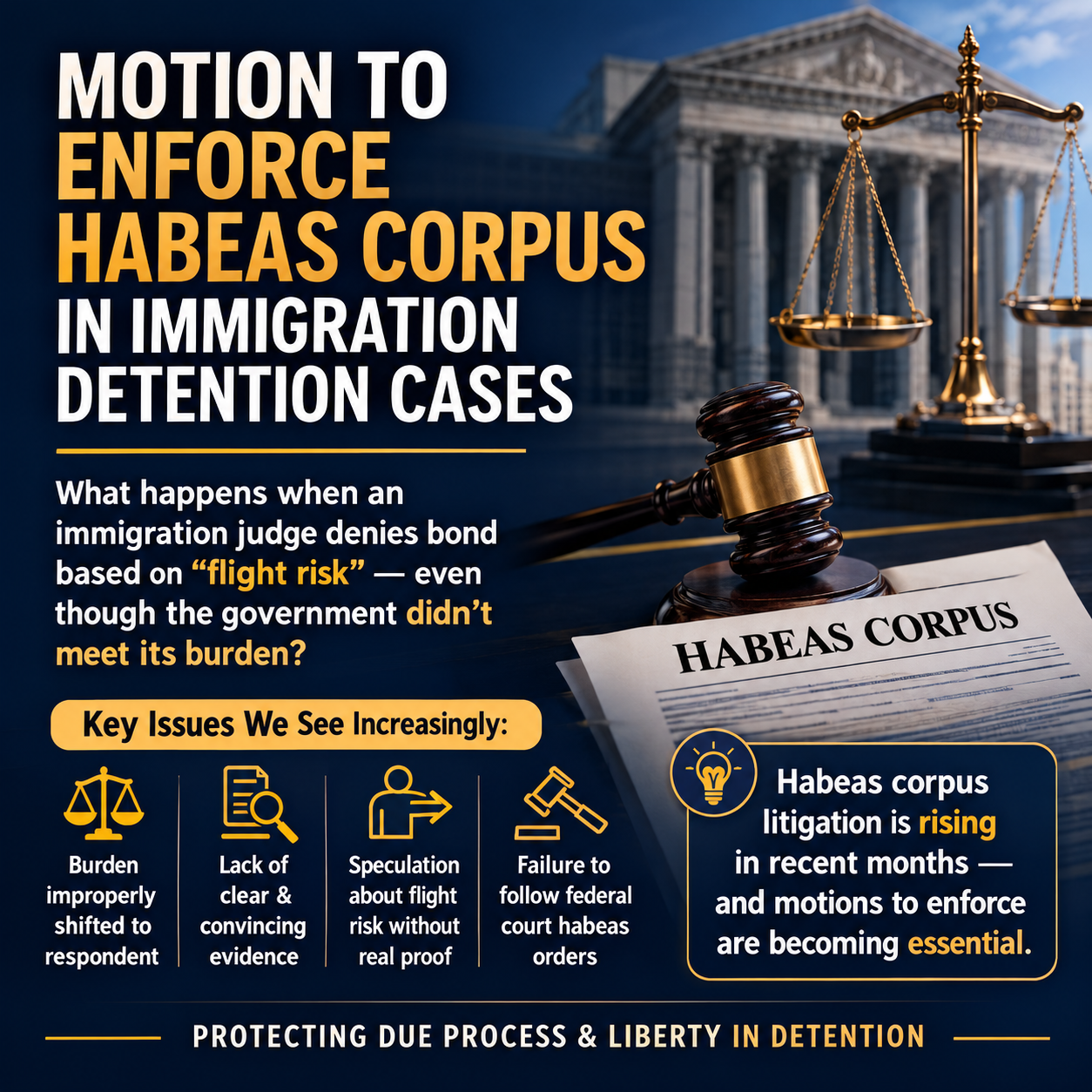
Hello everyone,
In recent months, federal habeas corpus litigation has become one of the most important tools for immigrants held in prolonged immigration detention. Across the United States, immigration detainees and their attorneys increasingly turn to federal district courts when bond hearings before immigration judges fail to provide meaningful due process protections.
A growing issue is now emerging after successful habeas corpus litigation: what happens when an immigration judge conducts a bond hearing, but effectively ignores the federal court’s order?
This problem appears more frequently than many people realize.
The Rise of Habeas Corpus Litigation in Immigration Cases
Immigration detention litigation has changed dramatically in recent months. In many jurisdictions, attorneys increasingly file petitions for writs of habeas corpus challenging prolonged detention under the Fifth Amendment and federal immigration statutes.
Federal courts have repeatedly recognized that prolonged civil immigration detention raises serious constitutional concerns. In many cases, district courts order the government to provide a new bond hearing before an immigration judge with specific procedural safeguards.
Those safeguards often include:
- placing the burden on DHS rather than the detained immigrant,
- requiring the government to prove danger or flight risk,
- applying the “clear and convincing evidence” standard,
- requiring individualized findings,
- prohibiting reliance on speculation or boilerplate conclusions.
However, obtaining the habeas order is often only the beginning of the fight.
A Serious Problem: Immigration Judges Shifting the Burden Back to the Respondent
One recurring issue in post-habeas bond hearings is that immigration judges sometimes effectively shift the burden back onto the detained immigrant, despite a federal court order explicitly requiring the government to carry the burden.
Instead of requiring DHS to affirmatively prove dangerousness or flight risk by clear and convincing evidence, some courts focus almost entirely on whether the respondent has “proven” strong enough equities.
This creates a constitutional problem.
Under a true clear-and-convincing-evidence framework, the government must present actual evidence demonstrating that detention remains necessary. Mere doubts, speculation, or minor inconsistencies should not satisfy that burden.
Yet in practice, some bond decisions rely heavily on:
- skepticism toward sponsors,
- minor inconsistencies in affidavits,
- assumptions about future compliance,
- generalized concerns,
- or the absence of perfect documentation.
In many cases, DHS presents little or no affirmative evidence at all.
Example From Litigation
In one recent immigration detention matter, a federal habeas corpus petition resulted in an order requiring a new immigration bond hearing where the government was required to prove flight risk or danger by clear and convincing evidence.
At the subsequent hearing, however, the immigration judge denied bond largely based on concerns regarding the proposed sponsor’s credibility and logistical details.
Among the issues discussed:
- the sponsor had known the detainee only briefly,
- certain apartment details were allegedly unclear,
- Google Maps did not clearly reflect all units at the sponsor’s address,
- affidavit formatting issues became a focus.
At the same time, DHS allegedly presented no meaningful affirmative evidence establishing that the detainee posed a danger or genuine flight risk.
This raises a major legal question:
Can detention continue merely because an immigration judge finds the respondent’s evidence imperfect — even where DHS itself failed to carry the burden imposed by the federal habeas order?
Many attorneys increasingly argue the answer is no.
Motion to Enforce Habeas Corpus
When immigration courts fail to comply with the federal district court’s habeas order, one possible remedy is a motion to enforce habeas corpus filed back in federal court.
This type of motion argues that:
- the agency failed to comply with the district court’s constitutional directives,
- the immigration judge applied the wrong burden,
- the hearing failed to satisfy due process,
- the court’s order was effectively undermined in practice.
Federal judges generally retain jurisdiction to enforce compliance with their own habeas rulings.
In some situations, attorneys may argue that:
- the immigration judge improperly shifted the burden,
- clear and convincing evidence was not actually applied,
- the decision relied on speculation instead of evidence,
- DHS failed to meet its evidentiary obligations,
- the hearing became fundamentally unfair despite the habeas grant.
Why “Clear and Convincing Evidence” Matters
The clear-and-convincing standard is not supposed to be symbolic language.
It is a heightened evidentiary burden designed to protect liberty interests.
Immigration detention is civil detention — not criminal punishment. Because of this, prolonged detention without meaningful procedural safeguards raises serious constitutional concerns.
If the government can continue detention based on vague concerns, unsupported assumptions, or credibility speculation without substantial evidence, then the protections ordered by federal courts become largely illusory.
That is why enforcement litigation is becoming increasingly important.
The Growing Importance of Federal Court Oversight
Many immigration practitioners now view federal habeas litigation as one of the few remaining mechanisms capable of providing meaningful review of detention practices.
In some detention facilities and immigration courts, attorneys increasingly report:
- prolonged detention,
- repeated bond denials,
- cursory analysis of evidence,
- inadequate application of constitutional standards,
- practical resistance to federal habeas rulings.
As a result, motions to enforce habeas corpus may become more common.
Federal courts are increasingly asked not merely to order a bond hearing, but to ensure that the hearing actually complies with constitutional requirements.
Habeas Corpus Litigation Is Increasing
Across the country, habeas corpus litigation in immigration detention cases appears to be increasing significantly in recent months.
This trend is driven by several factors:
- prolonged detention,
- restrictive bond practices,
- backlogged immigration courts,
- evolving constitutional litigation strategies,
- increasing reliance on federal district court intervention.
For many detainees, habeas corpus has become one of the only realistic avenues to challenge ongoing detention.
And when immigration courts fail to properly implement federal court directives, enforcement litigation may become the next battleground.
Conclusion
Winning a habeas corpus petition does not always end the detention fight.
In some cases, the real litigation begins after the immigration court conducts the “new” bond hearing.
When immigration judges fail to properly apply the burden of proof, disregard the clear-and-convincing evidence standard, or effectively require detainees to prove why they deserve release, attorneys may need to return to federal court and seek enforcement of the habeas order itself.
As immigration detention litigation evolves, motions to enforce habeas corpus are likely to become an increasingly important tool in protecting due process rights in immigration custody proceedings.
✍️ Written by Ernest Goodman, US Immigration & IP Law.
⚠️ Disclaimer by Ernest Goodman, Esq.
This article is intended for informational purposes only and does not constitute legal advice. Reading or relying on this content does not establish an attorney-client relationship.
.