





Cheap Title Reports vs. Professional Clearance
Hello everyone!
Today, we will discuss the consequences of relying on cheap title report services and automated trademark platforms in the entertainment industry.
Independent filmmakers operate under constant financial pressure. Production, post-production, music licensing, insurance, festival submissions, marketing, and distribution all compete for limited resources. It is therefore understandable that producers often look for the fastest and least expensive way to clear the title of a film or television project.
A company offering a $99 title report with same-day delivery can appear attractive. The producer receives a professional-looking document containing trademark records, internet search results, IMDb references, domain information, and perhaps dozens of similar titles. At first glance, it may seem that the legal issue has been addressed.
But there is an important distinction that filmmakers should understand:
A title search is not necessarily title clearance.
A search identifies information. Clearance requires someone to understand what that information means.
That difference can become extremely important later, particularly when a project is submitted to a distributor, streaming platform, broadcaster, festival, or Errors & Omissions insurance carrier.
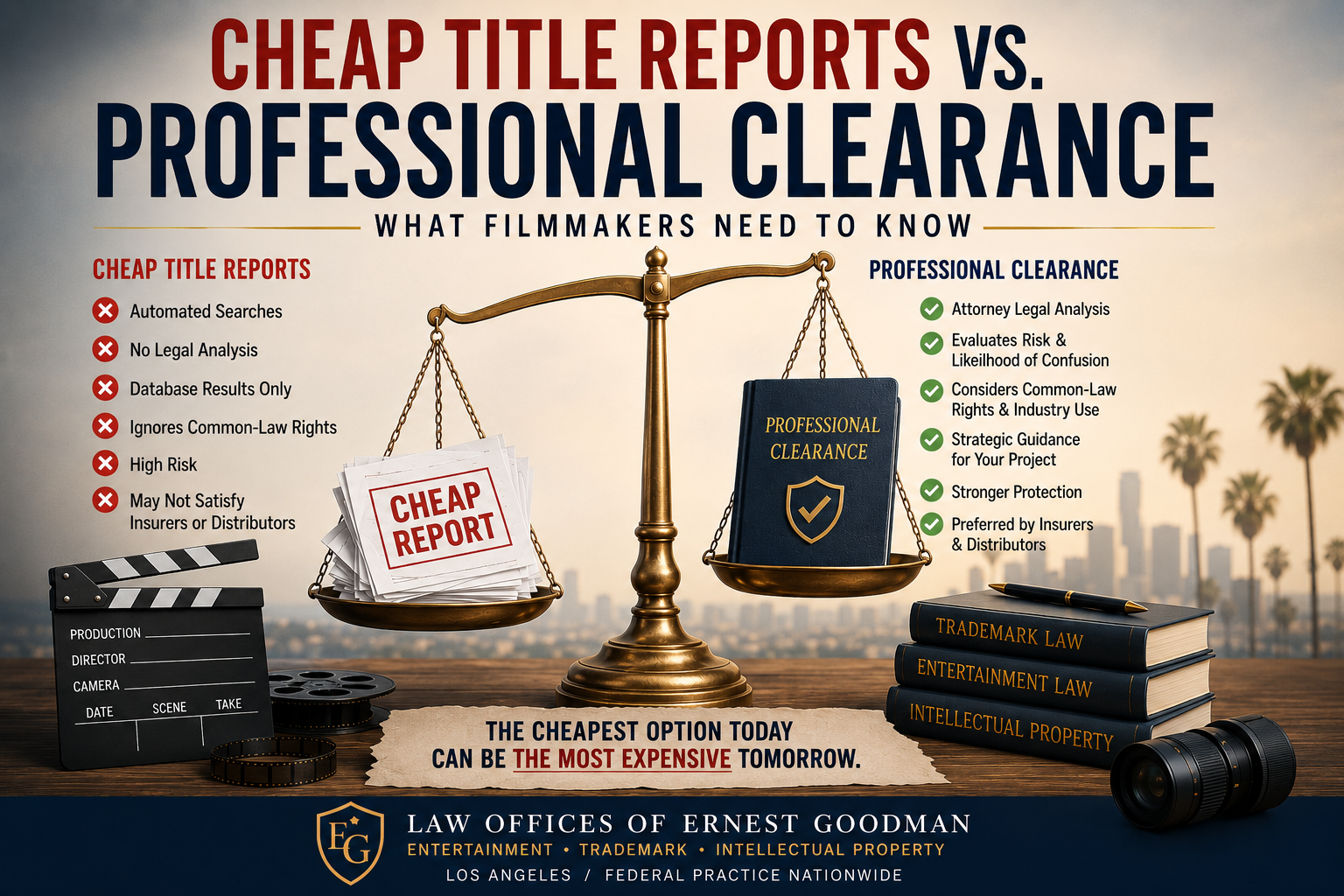
What Cheap Title Search Services Actually Provide
Many inexpensive title-search companies operate on a high-volume model. Their systems may search trademark databases, IMDb, internet results, domain registrations, social media, entertainment databases, and other publicly available sources.
There is nothing inherently wrong with those searches. In fact, many of the same databases may form part of a professional title-clearance investigation.
The problem is what happens after the information is collected.
A producer may receive fifty pages of search results showing similar trademarks, movie titles, podcasts, production companies, YouTube channels, websites, and social-media accounts. The report may look comprehensive because it contains a large amount of information.
But quantity of information is not the same as legal analysis.
The real question is not simply whether similar titles exist. Similar titles almost always exist.
The important question is:
How serious are those similarities?
That question cannot normally be answered by an automated database search alone.
A professional legal analysis considers whether the similarities create meaningful trademark risk, whether the respective businesses operate in related areas, whether consumers are likely to assume an affiliation, whether another owner possesses enforceable rights, and whether the practical risk justifies changing the title.
That requires judgment.
The Dangerous Meaning of the Word “Cleared”
One of the most dangerous misunderstandings occurs when a filmmaker receives a title report and begins describing the title as “cleared.”
The producer may say:
“We ordered the title report. Everything is fine.”
But what exactly was cleared?
Did someone merely search the databases?
Did an attorney actually evaluate the results?
Was likelihood of confusion analyzed?
Were common-law rights investigated?
Was the title examined in the context of entertainment services, merchandising, streaming, publishing, and potential franchise development?
Was the report intended to provide a legal opinion, or did the company expressly disclaim that it was providing legal advice?
These distinctions matter.
Many search companies intentionally stop short of providing legal conclusions. Some are not law firms and cannot provide legal advice. Their terms may expressly state that the report does not constitute legal clearance.
The filmmaker may therefore believe that legal clearance has been obtained while the service provider believes it merely supplied search data.
That misunderstanding frequently appears only when a distributor or insurance company asks more difficult questions.
Trademark Problems Do Not Require Identical Titles
Another misconception is that a title becomes dangerous only when somebody else has already used exactly the same words.
Trademark law is much broader.
Two titles can create problems because of similarities in pronunciation, appearance, meaning, or overall commercial impression. A small spelling difference may not eliminate confusion if consumers perceive the names as essentially the same.
Entertainment makes this even more complicated because projects exist within a connected media environment.
A movie may overlap commercially with a television series. A documentary title may resemble the name of a podcast. A film title may be similar to the name of an entertainment company, streaming channel, publishing brand, or established media franchise.
A title may also create problems even when the prior user does not operate in precisely the same medium.
For example, a producer may think:
“Their project is a podcast. Mine is a movie. We are different.”
Perhaps.
But the analysis does not end there. Podcasts become television programs. Films create podcasts. Media companies produce both. Entertainment properties routinely expand across platforms.
The relevant issue is how consumers understand the relationship.
An automated system can identify similar words. It is much more difficult for that system to determine whether the marketplace relationship creates meaningful legal risk.
Federal Trademark Registrations Are Only Part of the Investigation
Searching the USPTO database is important, but it is not enough.
In the United States, trademark rights can arise through use in commerce even without federal registration. This means that a production company, podcast, web series, YouTube channel, festival, entertainment brand, or other media project may possess legally significant rights even though nothing appears in the federal trademark database.
This is particularly important in entertainment markets such as Los Angeles and New York, where relatively small projects may develop meaningful recognition within a particular industry or audience.
Suppose a filmmaker searches the USPTO database and finds no registration for a proposed title.
That does not necessarily mean the title is available.
Another company may have used the name for years. It may have developed an audience, commercial relationships, press coverage, social-media recognition, or industry goodwill. Those facts can become legally significant even without a federal registration.
A meaningful title-clearance investigation therefore looks beyond the federal register.
It asks who is actually using the name, where it is being used, how long it has been used, what audience recognizes it, and whether the prior use overlaps commercially with the proposed project.
Entertainment Title Clearance Is Different
Entertainment titles create special problems because a successful project rarely remains only one product.
A film may begin as a motion picture, but success can lead to sequels, merchandise, soundtrack releases, podcasts, books, live events, games, licensing arrangements, streaming channels, international distribution, and other commercial extensions.
This means that title clearance should not always be based solely on what the project is today.
The producer should also consider what the project may become.
Imagine that an independent film is produced for a small festival run. The title appears relatively safe because there is little immediate commercial overlap with another user.
Then the film becomes successful.
A distributor acquires it. Streaming rights are sold. Merchandise is developed. A sequel is discussed. The project begins appearing internationally.
Suddenly, commercial relationships that seemed remote during production become much more significant.
Good title clearance therefore considers not only the immediate production but also the realistic commercial trajectory of the project.
Search Results Require Context
Suppose a title report identifies twenty similar marks.
That number alone tells the filmmaker almost nothing.
One of those marks may be extremely dangerous because it belongs to a major entertainment company actively producing content in the same market.
Another may belong to a small unrelated business operating in an entirely different industry.
A third may have been abandoned years ago.
A fourth may technically remain registered but have little marketplace presence.
A fifth may involve words that look similar in a database but create a completely different commercial impression when encountered by consumers.
Treating all five results as equivalent would be a mistake.
The purpose of legal analysis is to distinguish meaningful conflicts from background noise.
That distinction is often where experience becomes most valuable.
E&O Insurance Changes the Practical Analysis
Title clearance is not solely about whether the filmmaker believes a lawsuit would ultimately succeed.
Errors & Omissions insurance carriers evaluate risk differently.
An insurer may be concerned about the possibility of a claim even when the filmmaker has strong legal defenses. Litigation itself creates expense. A cease-and-desist letter can delay distribution. A demand for an injunction may make a distributor nervous. A threatened trademark dispute may interfere with a release schedule.
From the insurer’s perspective, a legally defensible title can still represent an undesirable risk.
This is why professional clearance often considers two related but different questions:
Could we probably defend this title legally?
and
Will insurers and distributors be comfortable with this title commercially?
Those questions do not always produce exactly the same answer.
A filmmaker may be willing to accept a moderate legal risk. A distributor investing substantial money into marketing may not.
Distribution Makes the Problem More Expensive
Title problems become much more serious once distribution discussions begin.
A distributor does not want to spend money promoting a movie only to discover that another rights holder may challenge the title.
Streaming platforms and broadcasters also have practical concerns beyond traditional trademark doctrine. Similar titles can create metadata confusion, search-result problems, marketing difficulties, and consumer ambiguity.
Even without litigation, a problematic title can create unnecessary friction during acquisition.
The producer may therefore receive an unpleasant request late in the process:
“Please change the title before delivery.”
At that point, the problem is no longer simply legal.
It becomes operational and financial.
The Hidden Cost of Rebranding
Changing a title early in development may cost almost nothing.
Changing it after post-production may cost a great deal.
By that stage, the title may already appear in posters, trailers, websites, social-media accounts, festival submissions, contracts, press materials, metadata, subtitles, artwork, distributor documents, and promotional campaigns.
The film may already have accumulated online recognition under that name.
A title change can therefore require new artwork, new promotional materials, website changes, trailer editing, revised deliverables, contract amendments, updated festival information, and new digital assets.
There may also be less obvious costs.
Search-engine results accumulated under the old title may become less useful. Reviews and press mentions may refer to the previous name. Audience recognition may be weakened. Investors and distributors may begin questioning why the project suddenly changed identity.
A title-clearance problem that might have cost several thousand dollars to address early can become dramatically more expensive later.
Winning a Lawsuit Is Not the Same as Winning Commercially
Entertainment litigation illustrates another important distinction.
A filmmaker may have a strong legal position and still suffer significant commercial damage.
Imagine that another company sends a cease-and-desist letter shortly before a scheduled release. The filmmaker believes the claim is weak and decides to fight.
Perhaps the filmmaker ultimately wins.
But what happened during the dispute?
The release may have been delayed. A distributor may have suspended negotiations. Investors may have become nervous. Marketing expenditures may have been wasted. Festival opportunities may have been lost.
Legal victory months or years later does not necessarily recover those opportunities.
This is why sophisticated entertainment companies often take title clearance seriously even when the probability of losing litigation appears relatively low.
Risk management is broader than courtroom probability.
Technology Is Useful — But It Is a Tool
Modern technology has dramatically improved trademark and title searching.
Automated databases can identify records faster than ever before. Artificial intelligence can assist with searching, categorization, and comparison. Search engines can uncover marketplace uses that would previously have required enormous manual effort.
These tools are valuable.
The mistake is assuming that better searching eliminates the need for legal judgment.
Technology is excellent at answering:
“What potentially similar things exist?”
The more difficult questions remain:
“Which of these results matter?”
“How much risk do they create?”
“What should the producer do about them?”
Those are strategic questions.
An automated system may identify that two names share words. An attorney must determine whether those words are legally significant in context.
Technology can find a registration. Legal analysis must determine whether the registration presents a serious obstacle.
AI may assist in organizing evidence. It does not eliminate professional responsibility for the ultimate judgment.
Why Professional Clearance Costs More
Filmmakers sometimes compare the price of an attorney’s title-clearance work with a low-cost online report and wonder why the difference is so significant.
The reason is that they are often comparing different services.
A database search can be automated and reproduced at scale.
Legal clearance requires investigation, analysis, judgment, and professional responsibility.
An attorney may need to examine ownership history, potentially abandoned marks, common-law use, the relationship between different entertainment services, the strength of competing trademarks, prior enforcement activity, marketplace overlap, and the project’s future commercial plans.
The attorney must then convert that research into practical advice.
The answer is rarely simply “yes” or “no.”
A proper conclusion may be:
The title appears relatively low risk.
The title presents moderate risk but may be acceptable for limited distribution.
The title should be modified before substantial marketing begins.
Additional investigation is required.
A consent or coexistence agreement should be explored.
The producer should select another title.
That type of advice is fundamentally different from receiving a spreadsheet of search results.
Cheap Trademark Filing Services Create the Same Problem
The same misunderstanding appears with inexpensive online trademark-filing services.
Many platforms advertise extremely low filing prices and rapid submission. A business owner enters information into an online questionnaire, software generates an application, and the application is filed.
Again, there is nothing inherently wrong with technology assisting the filing process.
The problem arises when the customer believes that filing the form is the same thing as developing a trademark strategy.
It is not.
The actual filing is often the easiest part.
The difficult questions arise before the filing:
Is the trademark strong?
Is it registrable?
Are there conflicting marks?
What goods and services should be included?
How should those goods and services be described?
Should multiple classes be filed?
How will the brand expand?
What happens if the company later adds merchandise, streaming services, publishing, or international operations?
These decisions can affect the value and enforceability of the trademark for years.
An inexpensive filing prepared without strategy may save money today while creating expensive problems later.
Poor Trademark Strategy Can Limit Future Growth
This issue is especially important in entertainment because successful intellectual property tends to expand.
A filmmaker may initially register a trademark only for entertainment services. Later, the project develops merchandise, clothing, publishing, podcasts, games, live events, or other products.
If the original strategy did not consider those possibilities, the company may discover that another business has obtained conflicting rights in an important area of expansion.
This is why trademark strategy should be connected to business strategy.
A good trademark lawyer does not merely ask:
“What are you selling today?”
The lawyer should also ask:
“What are you realistically planning to sell tomorrow?”
That future-oriented analysis can significantly affect filing decisions.
Independent Filmmakers Still Have to Make Practical Choices
None of this means that every independent filmmaker must spend an enormous amount of money on title clearance.
Legal services should be proportionate to the project.
A short film intended for a limited local audience presents a different risk profile from a feature film seeking worldwide streaming distribution.
A student project has different commercial objectives from a film backed by investors and intended for theatrical release.
A small documentary with limited exposure may reasonably use a more modest clearance process.
The important point is that producers should understand what they are buying.
A basic search report may be entirely appropriate for one project.
But it should not be mistaken for a comprehensive legal opinion when no legal analysis was actually performed.
The filmmaker should make that decision knowingly.
When Professional Clearance Becomes Particularly Important
The need for deeper review increases as the project’s commercial exposure grows.
A feature film intended for streaming, theatrical distribution, international licensing, significant festival participation, merchandising, or franchise development presents greater potential consequences if a title problem emerges.
The same is true when substantial money has already been invested in branding.
As the financial value of the project increases, the cost of changing direction increases with it.
At some point, saving several hundred or several thousand dollars on legal review becomes economically irrational if the producer is risking a much larger investment.
This is simply risk management.
Cheap Is Not Always Inexpensive
The central lesson is not that inexpensive services are inherently bad.
The lesson is that price and value are not the same thing.
A $99 report that provides useful preliminary information may be worth exactly what it costs.
But if a filmmaker relies on that report as a substitute for legal clearance and later spends $25,000 rebranding a finished project, the inexpensive service was not inexpensive at all.
The same principle applies to trademark applications.
Saving money on the filing stage can become costly if the application is poorly structured, important rights are omitted, a conflict is overlooked, or the brand later becomes difficult to enforce.
In intellectual property law, the cheapest decision at the beginning can sometimes become the most expensive decision at the end.
Final Thoughts
Title clearance is not simply the process of typing a movie title into a database and looking for identical matches.
It is an assessment of legal and commercial risk.
That assessment may involve federal trademark registrations, common-law rights, prior entertainment uses, industry relationships, consumer perception, distribution channels, insurance requirements, marketplace realities, and the future commercial direction of the project.
Technology can make searching faster.
It cannot make judgment unnecessary.
Independent filmmakers should therefore understand the distinction between a search product and a legal service. Both may have value, but they serve different purposes.
For a small project with minimal distribution, a basic report may sometimes be sufficient. For a commercially significant film intended for streaming, international licensing, theatrical distribution, major festivals, or long-term brand development, deeper legal analysis becomes increasingly important.
The same principle applies to trademark protection generally.
Filing forms is easy.
Searching databases is increasingly easy.
The difficult part is understanding what the information means, predicting where the risks may arise, and developing a strategy that protects the creative project as it grows.
Professional title clearance is therefore not merely a search. It is legal risk analysis combined with an understanding of the entertainment business.
And in entertainment law, preventing a problem early is usually far less expensive than trying to solve it after the audience, distributor, insurer, and opposing lawyer already know the title.
Ernest Goodman
Trademark and Intellectual Property Practice
Los Angeles / Federal Practice Nationwide
.