





Chain of Title: The #1 Reason Films Can’t Get Distribution
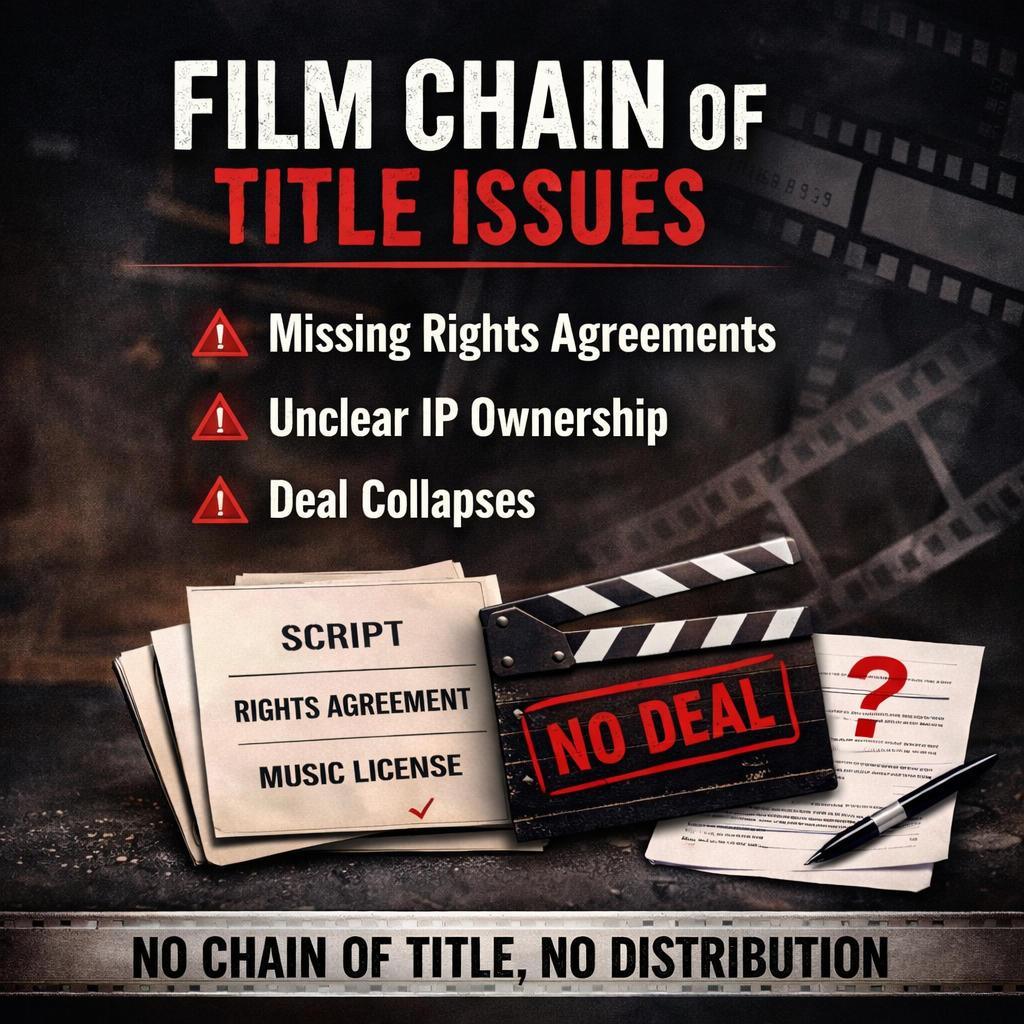
Independent filmmakers often believe that distribution depends on festivals, cast, or buzz. In practice, many completed films fail to secure distribution for a far less visible reason: broken or incomplete chain of title.
Chain of title issues rarely appear early. They surface when a film finally attracts interest—when a distributor, sales agent, or platform asks a simple question:
Do you actually own the rights you’re trying to sell or license?
If the answer is unclear, the deal stops.
What Chain of Title Really Is
Chain of title is the legal proof that the production company owns all intellectual property rights necessary to exploit the film, worldwide, in all media, for the full copyright term.
It is not a single document. It is a complete record showing a clean and uninterrupted transfer of rights covering:
– the script and any underlying material
– the director’s contributions
– actors’ performances
– music and sound recordings
– artwork, footage, and other embedded content
If even one contributor’s rights were never properly transferred, the chain is broken.
Why Distributors Care—Especially When IP Is Being Acquired
Distributors are risk managers. Their primary concern is not how the film was made, but whether acquiring or exploiting it exposes them to future claims.
This concern becomes critical whenever a deal involves permanent or quasi-permanent acquisition of IP rights. If ownership is transferring—or could be interpreted as transferring—distributors require acquisition-level chain of title.
Without it, they risk:
– copyright infringement lawsuits
– injunctions blocking release
– takedowns by contributors
– loss of insurance coverage
– investor claims for misrepresentation
A strong film with weak chain of title is not an opportunity—it is a liability.
Where Chain of Title Commonly Breaks
Most problems arise from early-stage informality. Common examples include:
– a writer who never signed an assignment or work-for-hire agreement
– a director contract that grants creative control but fails to transfer copyright
– music delivered “as a favor” without proper licenses
– actor releases that cover filming but not distribution or streaming
– adaptations of books, articles, or life stories without secured rights
These gaps often go unnoticed until a distributor’s legal review flags them.
Why “Everyone Agreed” Is Legally Meaningless
Under U.S. copyright law, ownership starts with the creator. Payment alone does not transfer rights.
Unless there is a signed written agreement assigning rights or establishing valid work-for-hire status, the contributor retains ownership—no matter how cooperative they were at the time.
Emails, text messages, verbal promises, and assumptions do not override copyright law. Distributors, insurers, and courts look only at what is documented.
MGs, Presales, and Licensing: Where Confusion Begins
Many chain-of-title problems are triggered by misunderstandings about deal structures—especially MGs, presales, and licensing agreements.
A Minimum Guarantee (MG) traditionally refers to an advance paid against future revenues in connection with a transfer of rights, often exclusive and sometimes permanent. Because IP is being conveyed, distributors treat MG deals as acquisitions and scrutinize chain of title accordingly.
However, many deals casually called “MGs” are not MGs in the legal sense.
In practice, distributors often advance money under licensing agreements, where:
– the producer retains ownership
– rights are licensed for a defined term and territory
– the advance is a licensing payment, not an MG
The confusion deepens with presales.
Presales: Same Word, Very Different Legal Outcomes
A presale simply means rights are sold before the film is completed. But presales can be structured in two fundamentally different ways:
1. Presale with an MG tied to IP transfer
The distributor advances money and acquires rights in a manner similar to an acquisition. Chain of title must be clean because ownership—or near-ownership—is changing hands.
2. Presale as a licensing agreement with an advance
The distributor advances money to license rights for a limited term. Ownership remains with the producer.
Despite being called “MGs” in conversation, these structures carry very different legal consequences.
The Critical Legal Principle: Substance Over Form
One of the most important rules filmmakers overlook is this:
The name of a contract is not legally significant.
What matters is what the agreement actually does.
A document titled “Licensing Agreement” may function as an IP transfer.
A document labeled “MG Agreement” may legally be only a license.
Courts, distributors, and insurers look at:
– what rights are granted
– whether the grant is exclusive
– whether rights revert
– whether ownership is assigned
– whether the term is limited or perpetual
If the substance of the deal resembles an acquisition, distributors will demand acquisition-level chain of title—regardless of the contract’s title.
How Chain of Title Problems Kill Deals in Practice
This is how deals typically fail:
– a distributor expresses interest
– a legal delivery checklist is requested
– missing or defective agreements are flagged
– fixes are demanded
– contributors are unreachable, uncooperative, or demand money
At that stage, leverage is gone. The film may be finished, but legally stuck.
Why Fixing Chain of Title Later Is Dangerous
Post-production fixes are possible—but risky and expensive.
Once a film has value, contributors know it. Assignments that would have been routine early on may now require renegotiation or may not happen at all.
Distributors do not want to inherit that uncertainty.
The Producer’s Legal Responsibility
Chain of title is not a creative issue. It is a producer responsibility.
A producer’s job is not only to make a film, but to deliver a legally marketable asset. Without clean chain of title, the project cannot be safely sold, licensed, or distributed.
What We Can Do
Chain-of-title problems are preventable—and often fixable with proper legal strategy.
We assist filmmakers by:
– auditing chain-of-title documents
– identifying missing or defective rights transfers
– analyzing whether a deal is truly an MG, a presale, or a license
– preparing acquisition-level chain of title when needed
– correcting documentation before money is advanced
– assembling distributor-ready legal delivery packages
A film should succeed or fail on its merits—not because of missing paperwork.
Clean chain of title protects your project, your leverage, and your future deals.
✍️ Written by Ernest Goodman, Entertainment & IP Law.
⚠️ Disclaimer by Ernest Goodman, Esq.
This article is intended for informational purposes only and does not constitute legal advice. Reading or relying on this content does not establish an attorney-client relationship. Because laws differ by jurisdiction and continue to evolve, readers are encouraged to consult a qualified attorney licensed in the relevant jurisdiction for advice tailored to specific circumstances.
.