





IP Strategy Plan and IP Portfolio for Film and Tech
Hello everyone,
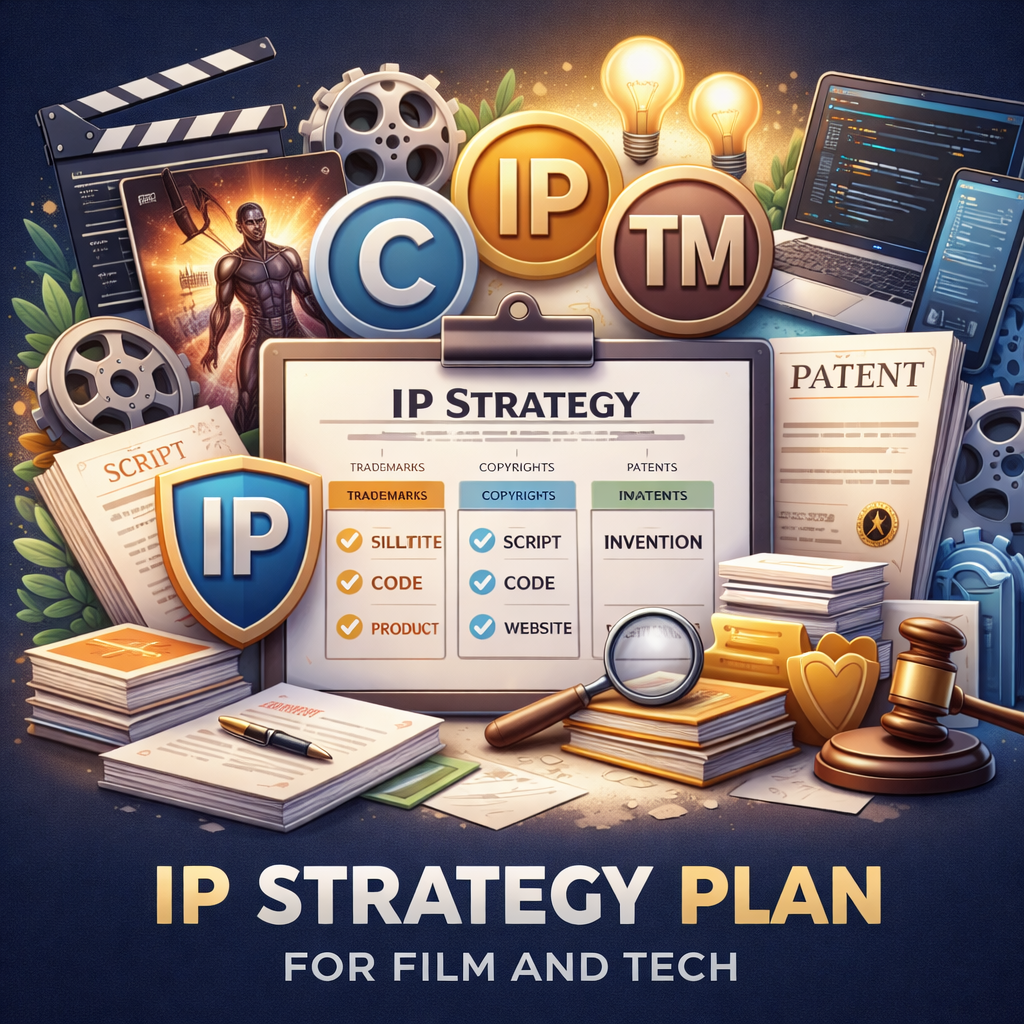
Today we will discuss the importance of an IP strategy plan, explain what an IP portfolio is in practical terms, and show how this applies—step by step—to both film projects and technology companies. We will also explain how we help creators and founders build and protect these portfolios in a way that supports real-world deals.
What an IP Strategy Plan Really Means
An IP strategy plan is the starting point for any serious creative or technology project. It is not a filing exercise and not a bureaucratic requirement. It is a deliberate planning process that looks at the project as a business asset from day one.
At this stage, we identify what is being created now and what will be created later. We analyze how those assets will be used commercially, how long they are expected to live, and what risks exist if ownership or protection is unclear. This planning phase allows the project to grow without constantly needing to “fix” legal problems retroactively.
In practice, the IP strategy plan functions like architectural drawings for a building. Without them, construction might begin, but structural problems will eventually appear.
What Is an IP Portfolio
An IP portfolio is the organized body of intellectual property rights that belong to a project or company. It reflects the result of the IP strategy plan in action.
An IP portfolio is not one registration or one contract. It is the combined legal framework that shows ownership, protection, and control over creative or technical output. A strong portfolio allows third parties—such as distributors, investors, platforms, or acquirers—to quickly understand what exists, who owns it, and how it can be used.
Well-built IP portfolios are often the most valuable assets a company or production owns, even though they do not appear as physical property.
IP Portfolio in Film: How It Works in Practice
A film is never a single piece of intellectual property. It is a collection of rights that together form a portfolio.
At the branding level, a film generates identifiers that function in the marketplace. These include the film title when used commercially, the name of a series or franchise, logos, taglines, and sometimes character names used beyond the story itself. These identifiers are protected through trademark law and allow the film to exist in the commercial ecosystem without confusion or dilution.
At the creative level, the film produces multiple works of authorship. The screenplay is one work. The completed motion picture is another. Posters, key art, trailers, promotional stills, and marketing materials are all independent works. Each one has its own value and its own lifecycle. Copyright law protects these works and allows them to be licensed, distributed, and enforced separately.
Ownership ties everything together. A film IP portfolio only works if the production entity clearly owns the rights it claims. This requires proper work-for-hire agreements, assignments from contributors, and documentation that shows how rights moved from individuals to the production company. This “chain of title” is the backbone of every film deal and is often reviewed before anything else.
When all of these elements are aligned, the film’s IP portfolio becomes a tool that supports financing, distribution, international sales, sequels, spin-offs, and merchandising.
IP Portfolio in Tech: Same Structure, Different Assets
Technology companies build IP portfolios using the same logic, even though the assets look different.
At the market level, trademarks protect the company name, product names, logos, and slogans. These elements define how users and investors recognize the product. Strong trademark protection allows the company to scale without risking confusion or forced rebranding later.
At the technical level, copyright protects the expressive aspects of software. Source code, user interfaces, documentation, websites, and marketing content are all protected works. Ownership is especially critical here. If developers or contractors have not properly assigned their rights, the company may not legally own its own product—even if it paid for development.
In some cases, patents are added to the portfolio to protect functional innovations. Patents are not automatic or universal; they are strategic tools used when the technology itself creates a defensible competitive advantage. Deciding whether to pursue patents is part of the IP strategy plan, not an afterthought.
A well-structured tech IP portfolio supports fundraising, licensing, platform partnerships, and eventual acquisition.
Why IP Portfolios Matter in Real-World Deals
When a distributor, investor, or acquirer evaluates a project, they are not only looking at creativity or technical merit. They are looking for certainty.
A clear IP portfolio answers the most important questions: what exists, who owns it, how it is protected, and whether it can be scaled or transferred. Projects without this clarity often face delays, reduced valuations, or failed deals.
IP portfolios reduce risk. Reduced risk increases value.
How We Help
We help filmmakers and technology companies design, build, and maintain IP portfolios that are aligned with real business goals.
Our work begins with the IP strategy plan. From there, we map assets to the appropriate forms of protection, structure ownership and chain of title, and coordinate the legal steps needed to make the portfolio enforceable and commercially viable. We focus on preventing problems before they arise and preparing projects for distribution, investment, or growth.
We do not treat IP as paperwork. We treat it as infrastructure.
Closing Thought
Whether you are developing a film, launching a platform, or building a company, the underlying principle is the same. Creativity and innovation are what create value in the first place, but value alone is fragile. Without structure, it can be copied, diluted, or taken by others with fewer scruples and stronger legal positioning.
Strategy is what transforms creative and commercial value into enforceable legal assets. It determines how that value is defined, where it is protected, and how it can be defended or monetized over time. An intellectual property portfolio then preserves and grows those assets, allowing them to support expansion, licensing, investment, and long-term brand equity rather than remaining vulnerable or underutilized.
If you are building something intended to last, something that goes beyond short-term use or experimentation, we are here to help you structure it correctly from the beginning and protect it in a way that aligns with your long-term goals.
✍️ Written by Ernest Goodman, Entertainment & IP Law.
⚠️ Disclaimer by Ernest Goodman, Esq.
This article is intended for informational purposes only and does not constitute legal advice. Reading or relying on this content does not establish an attorney-client relationship. Because laws differ by jurisdiction and continue to evolve, readers are encouraged to consult a qualified attorney licensed in the relevant jurisdiction for advice tailored to specific circumstances.
.