





Social Media as Legal Risk in Film
Introduction: The Risk Has Moved
Film production has always involved risk. Financing can collapse, creative visions can fracture, and distribution can fall apart late in the process. Historically, however, these risks were largely internal and predictable. They arose from contracts, business relationships, or market forces.
What has changed is the location of risk.
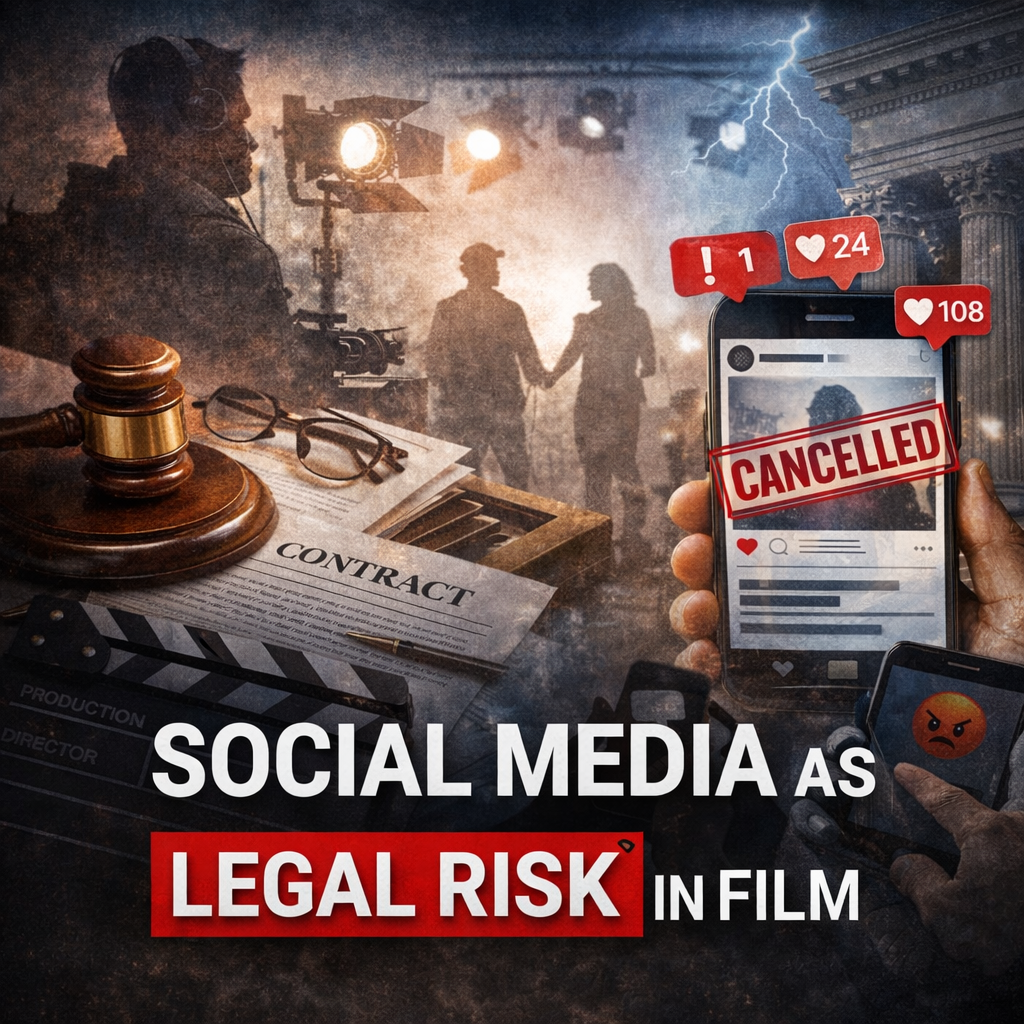
Today, some of the most serious legal exposure in film production arises not from the script or the financing structure, but from social media. Informal posts, interviews, reposts, and commentary made outside official promotional channels can now determine whether a project remains stable or becomes legally compromised.
From a legal perspective, social media is no longer ancillary. It is part of the production’s operational reality and must be treated accordingly.
The Expansion of the Legal Perimeter
In earlier eras, legal exposure in film production was largely contained within professional boundaries. Statements made on set, in press junkets, or through authorized publicity channels were reviewed and managed. Risk was centralized.
That perimeter no longer exists.
Every individual connected to a film now controls a personal media channel with instantaneous reach. Statements made on personal accounts are no longer meaningfully distinguishable from official statements in the eyes of investors, insurers, distributors, or courts. The distinction between “personal opinion” and “project-related conduct” has eroded.
As a result, productions are increasingly evaluated not only by what appears on screen, but by the total digital footprint surrounding the project. Legal exposure now follows the individuals involved, not just the entity that produces the film.
Contractual Consequences of Online Conduct
Most film professionals underestimate how directly social media conduct intersects with contractual obligations.
Talent agreements, producer agreements, and investor documents often contain provisions addressing public conduct, reputation, publicity, confidentiality, and cooperation. These clauses were once considered background provisions. Today, they are operational clauses.
When controversy arises, the legal inquiry is immediate and practical. Counsel is asked whether the conduct falls within contractual prohibitions, whether discretion exists to impose remedies, and whether enforcement would withstand scrutiny. The analysis is not moral or political. It is contractual.
Importantly, intent rarely matters. A well-intentioned post can still trigger remedies if it materially affects commercial value or reputational standing. In many disputes, the decisive factor is not whether the speaker meant harm, but whether harm occurred.
Pre-Release Defamation Risk in the Social Media Era
One of the most legally dangerous aspects of social media is the creation of defamation exposure before a film is released.
Cast or crew may publicly frame a project as telling a “true story,” exposing corruption, or being inspired by real people. Even when scripts are carefully fictionalized, such statements can later be used to establish identification, intent, or reckless disregard for truth.
Courts evaluating defamation claims do not isolate the film from its surrounding context. Promotional statements, interviews, and online commentary are all considered part of the evidentiary record. Social media posts are discoverable, archivable, and often preserved by third parties long after deletion.
A single post can undermine months of legal risk mitigation.
Confidentiality, NDAs, and Casual Disclosure
Behind-the-scenes content has become culturally normalized, but legally it remains hazardous.
Confidentiality provisions are not limited to scripts or formal announcements. They often cover development materials, casting discussions, internal disputes, financial information, and strategic decisions. Informal disclosure through social media can constitute a technical breach even if no harm was intended.
Such breaches frequently become leverage points. Investors, partners, or distributors may invoke them not merely to enforce confidentiality, but to renegotiate terms, delay obligations, or exit relationships. In this sense, social media disclosure can destabilize projects indirectly, even when no immediate lawsuit follows.
Morals Clauses in the Digital Era
Morals clauses have undergone a quiet but profound transformation.
Historically, these clauses were designed to address extreme situations: criminal conduct, public scandal, or behavior so egregious that it threatened a project’s viability. They were invoked rarely and often reluctantly.
In the digital era, morals clauses have become active risk-allocation mechanisms.
Modern clauses are frequently drafted using broad language referring to conduct that brings a production into public disrepute or subjects it to public contempt. In a polarized and hyper-reactive online environment, reputational damage no longer requires unlawful conduct. Public backlash alone may be sufficient.
The central legal issue is discretion. Broadly drafted morals clauses grant one party the authority to determine whether reputational harm has occurred and what remedies are appropriate. Those remedies may include suspension of services, removal from marketing, withholding of compensation, or termination.
This discretion fundamentally shifts leverage. Morals clauses can be invoked strategically during internal disputes, creative conflicts, or financial renegotiations. What begins as a reputational issue can quickly become a governance issue.
The risk is compounded by ambiguity. Many clauses do not clearly define triggering conduct, evidentiary standards, notice requirements, or cure periods. In the absence of precision, enforcement decisions become subjective, increasing the likelihood of dispute and litigation.
In the digital era, morals clauses are no longer emergency provisions. They are daily governance tools, whether producers intend them to be or not.
Insurance and Coverage Implications
Errors and omissions insurance is often misunderstood as a safety net that absorbs reputational risk. In reality, insurers assess conduct as carefully as content.
When online activity suggests reckless promotion, defamatory framing, or disregard for legal guidance, insurers may question coverage. Coverage disputes frequently arise not from the film itself, but from statements made around it.
Productions often discover too late that insurance does not cure preventable exposure. It merely manages risk that could not reasonably be avoided.
Governance Failure and the Cost of Reactivity
The most common underlying problem is governance failure.
Many productions invest heavily in creative development and financing structure while neglecting digital risk management. Without defined protocols for public communication, legal review of sensitive statements, and internal escalation processes, responses to controversy are improvised.
Improvised responses create inconsistent narratives, contractual missteps, and insurance complications. From a legal standpoint, reactive management is always more expensive and more dangerous than preventive planning.
The Professional Standard: Legal Screening as Discipline
At the professional level, significant public-facing actions should be evaluated through legal counsel before execution.
This is not about suppressing expression or creativity. It is about recognizing that reputational exposure has legal consequences. Sophisticated producers, studios, and financiers do not make public moves casually when foreseeable risk exists. They screen announcements, promotional framing, and responses to controversy with legal input.
This discipline reflects experience, not caution. Informality is expensive. Structure is protective.
New York and California Law: Why Jurisdiction Matters
The legal impact of social media conduct in film production depends heavily on governing law. Two jurisdictions dominate the U.S. entertainment industry—California and New York—and they approach contractual enforcement, morals clauses, and reputational disputes in meaningfully different ways.
Understanding these differences is not academic. It directly affects how social media controversies are evaluated, litigated, and resolved.
California: Public Policy, Fairness, and Judicial Skepticism
California courts approach morals clauses and reputational enforcement with a strong awareness of public policy, particularly where personal expression and employment relationships intersect.
While morals clauses are enforceable under California law, courts tend to scrutinize them closely. Broad or vague language may be narrowed in application, especially if enforcement appears arbitrary or disproportionate. California judges are sensitive to the risk that morals clauses can become tools for pretextual termination rather than genuine reputational protection.
California’s legal culture also reflects heightened concern for speech, privacy, and employee protections. When social media conduct involves political expression or personal opinion, courts may hesitate to enforce punitive contractual remedies unless the connection to actual commercial harm is clear and well-documented.
In practice, this means that invoking a morals clause in California requires discipline. Productions must demonstrate a concrete nexus between the online conduct and material damage to the project. Improvised or emotionally driven enforcement increases the risk of wrongful termination claims, breach-of-contract disputes, or adverse judicial interpretation.
California law rewards preparation. It punishes reaction.
New York: Contractual Autonomy and Textual Enforcement
New York courts approach these issues from a different angle.
New York places significant weight on freedom of contract. Where sophisticated parties negotiate and agree to contractual terms, courts are generally inclined to enforce those terms as written, even when they grant broad discretion.
Morals clauses governed by New York law are therefore often more powerful. If the contract clearly allocates discretion to one party to determine whether conduct has brought a project into public disrepute, New York courts are less likely to second-guess that determination, absent bad faith or clear abuse.
This contractual autonomy extends to reputational risk. New York courts are more willing to accept that reputational harm itself constitutes legitimate commercial damage, even if the underlying conduct is not unlawful.
As a result, social media conduct that might survive scrutiny under California law may trigger enforceable remedies under New York law, provided the contract was clearly drafted.
Choice of Law as Risk Allocation
The choice between New York and California law is not a technical detail. It is a strategic decision that allocates power.
California law tends to protect individuals from overbroad enforcement and requires clearer justification for reputational remedies. New York law tends to protect contractual expectations and enforce negotiated discretion.
Producers, talent, and investors often focus on economics and creative control while overlooking governing law provisions. In the context of social media risk, that oversight can be decisive.
The same online controversy may produce entirely different legal outcomes depending on which law governs the agreement.
Practical Implications for Film Productions
In the digital era, jurisdiction determines leverage. It influences whether a morals clause becomes a shield or a sword, whether social media conduct is treated as personal expression or contractual breach, and whether disputes resolve quietly or escalate into litigation.
Sophisticated productions account for this at the drafting stage. They align governing law with their risk tolerance, enforcement strategy, and dispute posture long before controversy arises.
Once a social media crisis unfolds, jurisdiction is no longer negotiable. It is already embedded in the contract.
Conclusion: Social Media Is Structural, Not Peripheral
Social media is no longer peripheral to film production. It is a structural element of legal risk that directly affects contracts, insurance coverage, investor confidence, distribution viability, and litigation exposure. Decisions made online—often casually and without review—can carry the same legal consequences as decisions made in the boardroom or on set.
The modern film set does not end when the cameras stop rolling. It continues online, in public, and permanently. Statements, images, and commentary remain accessible long after the context that produced them has faded, and they are evaluated not as isolated moments, but as part of a continuing record.
The difference between a manageable controversy and a destabilizing legal crisis often turns on a single question: was the risk anticipated and structured for in advance, or was it ignored until consequences became unavoidable?
✍️ Written by Ernest Goodman, Entertainment & IP Law.
⚠️ Disclaimer by Ernest Goodman, Esq.
This article is intended for informational purposes only and does not constitute legal advice. Reading or relying on this content does not establish an attorney-client relationship. Because laws differ by jurisdiction and continue to evolve, readers are encouraged to consult a qualified attorney licensed in the relevant jurisdiction for advice tailored to specific circumstances.
.