





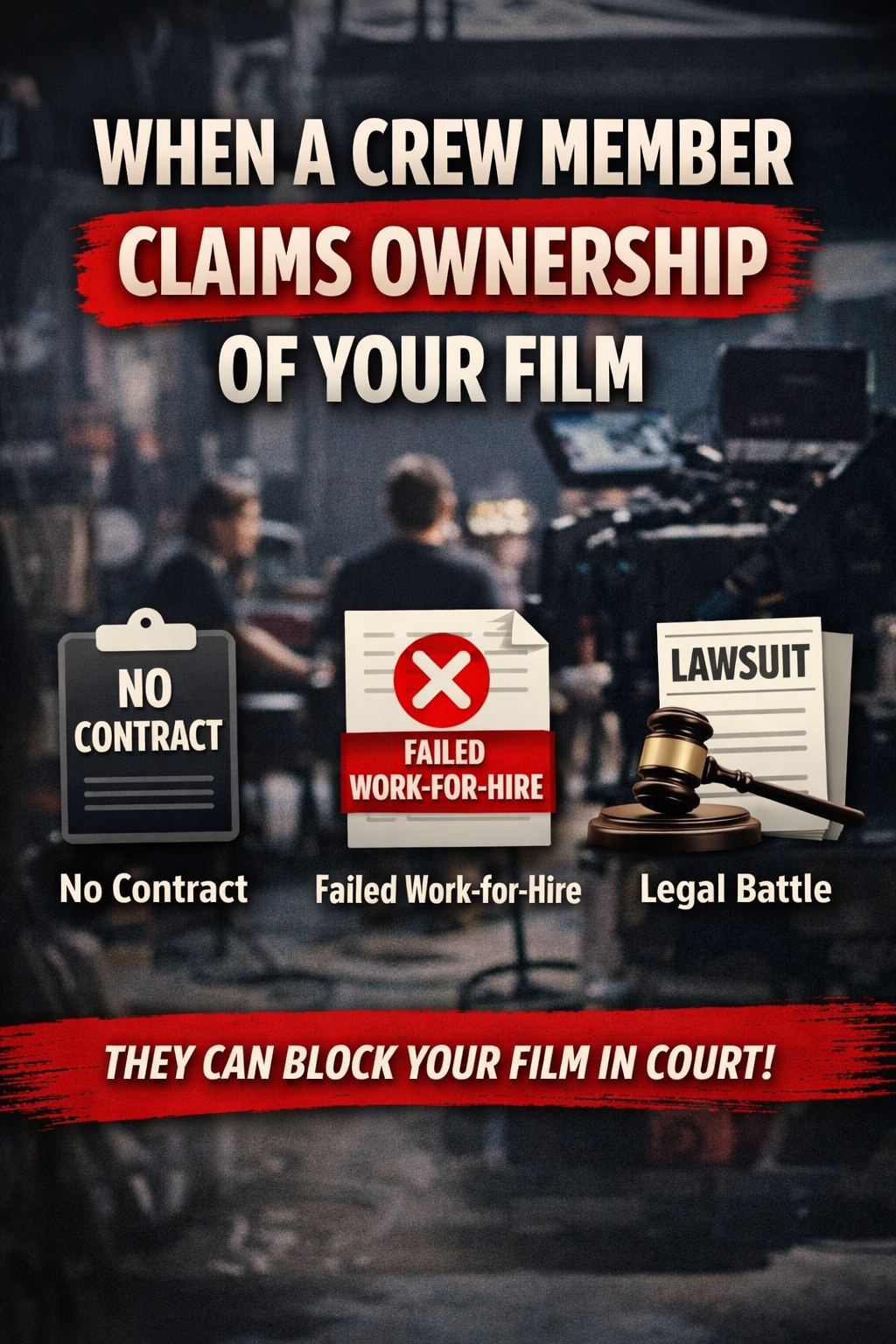
🎬 What Happens When a Crew Member Claims Ownership
Hello everyone,
Today, we will talk about work-for-hire agreements.
In film production, ownership is often assumed—but rarely verified.
Many filmmakers operate under the belief that once a project is completed, the film “belongs” to the producer or the production company. That assumption may feel intuitive, especially when one party finances, organizes, and oversees the entire production.
Legally, however, ownership does not follow effort, leadership, or payment. It follows authorship and written agreements.
And when those agreements are missing—or improperly drafted—a single crew member can disrupt the entire project by asserting ownership rights.
The Core Issue: Ownership Is Not Automatic
Film is inherently collaborative. Every major component of a film—script, footage, editing, music—can be independently protected under copyright law.
Under U.S. law, the default rule is clear:
The creator of a work owns the copyright, unless there is a valid written agreement transferring those rights.
This means:
– The cinematographer may own the footage
– The composer may own the score
– The editor may claim rights in the edited version
– The writer may retain rights in the script
Without proper legal structuring, a “film” is not a single asset—it is a bundle of separate copyrights.
The Illusion of Control
Many producers believe they control the project because:
– They paid for production
– They hired the crew
– They organized the project
But payment alone does not transfer copyright.
Calling someone a “contractor” does not transfer copyright.
Even full creative control during production does not transfer copyright.
Ownership must be explicitly transferred in writing.
Without that, control is an illusion.
Improper Work-for-Hire Arrangements Can Fail
The concept of “work made for hire” is widely used in the film industry—but often misunderstood and incorrectly implemented.
For a work-for-hire arrangement to be valid under U.S. law, several requirements must be satisfied:
– The agreement must be in writing
– It must be signed by both parties
– It must explicitly state that the work is a “work made for hire”
– The work must either be created by an employee within the scope of employment, or fall within specific statutory categories
If these requirements are not strictly met, the work-for-hire designation can fail entirely.
This is where many projects become vulnerable.
A common mistake is relying on informal agreements, emails, or generic templates that include the phrase “work for hire” without properly structuring the relationship or ensuring compliance with statutory requirements.
When challenged, those agreements may not hold.
And if the work-for-hire provision fails, the creator may retain ownership.
Backup Protection: Copyright Transfer Clauses
This is where many projects either survive—or collapse.
Even if a work-for-hire provision is later found invalid, a properly drafted copyright assignment clause can still transfer ownership.
A strong agreement typically includes:
– A clear statement that all rights are assigned to the production company
– Language covering present and future rights
– Transfer of all exclusive rights under copyright law
– Irrevocable assignment provisions
In practice, this means:
Even if the work-for-hire fails, the rights are still contractually transferred.
Without this backup clause, the failure of a work-for-hire provision can leave ownership with the creator.
This distinction is critical—and often overlooked.
When Ownership Claims Arise
Disputes rarely happen during production. They arise when the project becomes valuable.
Typical trigger points include:
– Acceptance into film festivals
– Interest from distributors or streaming platforms
– Revenue generation or licensing deals
– Public recognition or awards
At that moment, a contributor may assert:
“I never signed away my rights.”
And if the paperwork is weak, that claim may have legal merit.
Real-World Consequences
When a crew member asserts ownership, the issue is not theoretical—it is immediately commercial.
Distributors, sales agents, and platforms require a clean chain of title. This means:
– All rights must be clearly owned by a single entity
– All contributors must have transferred their rights
– Documentation must be complete and consistent
If ownership is disputed:
– Deals may be delayed or terminated
– Errors and Omissions (E&O) insurance may be denied
– Legal risk increases significantly
– The film may become effectively undistributable
In some cases, producers are forced to renegotiate rights under pressure—often at a much higher cost.
In worst-case scenarios, the project cannot move forward at all.
Common Structural Failures
Ownership disputes are rarely accidental. They are usually the result of predictable structural failures:
– No written agreements with key contributors
– Reliance on generic or incomplete templates
– Missing signatures or improperly executed documents
– Overreliance on “work-for-hire” language without legal compliance
– Absence of a backup copyright assignment clause
– Inconsistent documentation across departments
Each of these issues weakens the chain of title—and increases the risk of future claims.
Litigation Perspective
If the dispute escalates into litigation, the analysis becomes strictly document-driven.
Courts will not consider assumptions or informal understandings. They will examine:
– Whether a valid work-for-hire agreement exists
– Whether there is a signed copyright assignment
– Who created the work
-:What rights were explicitly transferred
– The exact language of the agreements
If the documentation is unclear or incomplete, the outcome becomes uncertain—and often expensive.
Prevention: Build Ownership from the Start
Ownership is not something that can be fixed at the end of production. It must be built from the beginning.
A properly structured film project includes:
-Written agreements with every contributor
– Valid work-for-hire provisions where applicable
– Strong copyright assignment clauses as backup
– Consistent and centralized documentation
– Ownership held by a single production entity (typically an LLC)
This is not excessive legal work—it is the foundation that allows the film to exist as a commercial asset.
Final Thought
A film can be creatively complete and still be legally unusable.
When a crew member claims ownership, the issue is not conflict—it is structure.
And structure is determined long before the camera starts rolling.
✍️ Written by Ernest Goodman, US Immigration & IP Law.
⚠️ Disclaimer by Ernest Goodman, Esq.
This article is intended for informational purposes only and does not constitute legal advice. Reading or relying on this content does not establish an attorney-client relationship. Because laws differ by jurisdiction and continue to evolve, readers are encouraged to consult a qualified attorney licensed in the relevant jurisdiction for advice tailored to specific circumstances. Ernest Goodman is a lawyer licensed in the State of New York.
.